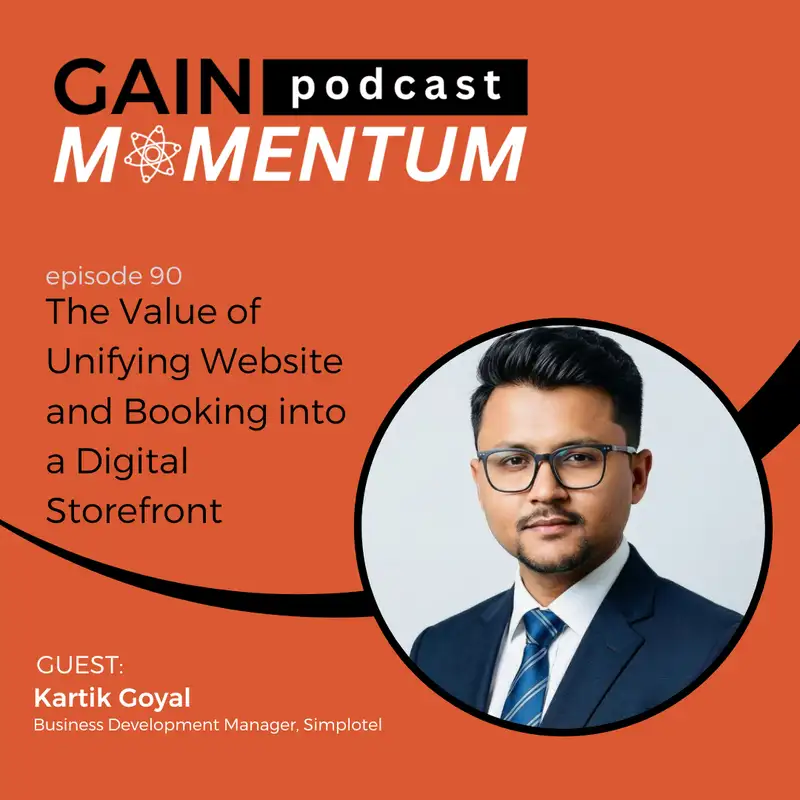
The Value of Unifying Website and Booking into a Digital Storefront | with Kartik Goyal
GAIN Momentum episode #90: The Value of Unifying Website and Booking into a Digital Storefront | with Kartik Goyal
===
Adam Mogelonsky: Welcome to the GAIN Momentum Podcast, on timeless lessons from senior leaders in hospitality, food service, travel, and technology. My co-host today is Vincent Somsen and our special guest today is Kartik Goyal, Business Development Manager at Simplotel. Kartik, how are you?
Kartik Goyal: I'm doing great, Adam, how are you?
Adam Mogelonsky: doing? Good. You're joining us from India today, is
Kartik Goyal: Absolutely. It's night day. Yeah.
Adam Mogelonsky: Yeah, so we have uh, three time zones here. I'm in Toronto, vincent de in valencia, and uh, you are in delhi, I believe.
Kartik Goyal: Yeah, I'm in Delhi right now.
Adam Mogelonsky: Yeah. Well, I mean it's, it speaks to the global nature of hospitality as well as in this relentless move towards cloud-based technologies. You don't need to have a software company that's based outta your hometown or your own country or market. It's nice, but we're dealing with global software companies that can deploy everywhere. Um. Minus some issues around, uh, data residency and, uh, data transit. But, uh, that is the nature of our industry and it's a very important point because, uh, sIM Hotel has a lot of clients from around the world. So why don't you start by discussing what Simplot Hotel is, uh, and how many clients you have, the diversity of those clients, and, uh, what your technology does.
Yeah. Awesome. Um, been very
Kartik Goyal: clear in life helping hotel and resorts grow direct online bookings through their own website. So what happens, Adam, is most of the hotels think they lose bookings to online travel agents because of marketing budgets. But we have seen what we have seen over the last 10 years is. it's actually a technology and experience gap, not a demand gap. Guests want to book direct, but they just don't want friction. So what we are doing is we are helping overcome this problem by building the hotel's brand website and booking engine together. So most of the hotel, website and booking engine treat each other as stranger, we build it together. So the guest journey feels fast, familiar, and trustworthy. Um, today we work with around 3000 plus hotels across 26 countries. And one thing, what we have consistently see is that bookings coming from hotels on website deliver the highest rev bar. So yeah, that's what we do for a living. We have quite split of customers across 26 countries. We have customers in North America, Caribbean, Asia Pacific. Yeah, a lot of places.
Adam Mogelonsky: So Kartik uh, drilling down to the history of Simtel is there is something to be said about the number of clients you have and getting to that point where you now have thousands of clients worldwide, independents, small groups, et cetera. Walk us back to the founding of Simple Hotel. What was the minimum viable product and how did you really gain traction, uh, in the hotel industry?
Kartik Goyal: Yeah. Awesome. So you are taking back us to the old days. Very nice. Um, so Adam, when Simplotel started, when we started, the core problem was very obvious. Hotels were getting online bookings, but most of them were coming through. travel agents, online travel agents, and at a very high commission cost. So OTs are very strong at technology. For example, if you visit Expedia, search for hotel and don't book, They will immediately follow up with emails or SMS. They will show you member discounts and remind you with the live pricing, Hotels didn't have this kind of technology at them, so their website and booking engine is still disconnected. So our MVP was very simple. We focused on bringing conversion focused OT elect technology to the hotel's own website. So whatever all these things OTA does, we do it on hotel's website, and booking engine. That's why we build this website and booking engine as one integrated system. And if I talk about some of our early customers. uh, we had Serenity Hotels and Resorts. It's a chain based in California. We have enthusiast hotel collection, we have server and ster group of hotels as well. So these were the hoteliers who believed that dur end bookings could actually become a serious channel. not just an add on to their one of the channel. So yeah, that's what we do.
Vincent Somsen: Kartik, where are you currently servicing, uh, these hotels? Is it only, uh, in India or are you in, uh, in other diff different countries as well?
Kartik Goyal: so currently Vincent, we have two offices. One of our offices in New York and one of our headquarters are in Bangalore, India. So we operate from these two offices, uh, globally. Yeah.
Vincent Somsen: I gotcha. Um, and do you have, you know, what kind of clients do you serve in uh, in the US for example? Um, is it, uh, you know, really those, those boutique hotels, smaller groups, um, or have you succeeded in already getting, uh, some larger groups as well? Yeah.
Kartik Goyal: Um, so great question Vincent. So our main focus is on independent boutique hotels. And the smaller group of domestic hotels. So in every country or every city you see there are a lot of national chains. So our focus has always been to those national chains to empower those national chains to grow their direct bookings. So yeah, that was our focus.
Vincent Somsen: Okay, that makes sense.
Kartik Goyal: Yeah.
Vincent Somsen: in terms of the other booking engines out there, what do you think, um, is really what differentiates you guys? You mentioned, uh, that you have, uh, systems that you, that you, uh, offer on your, as a, as a unified solution. Right? So hotels don't have, to have five different tools, five different vendors for a booking engine, a channel manager, a CRS, um, and, and whatnot. Um, would you say that's one of the value propositions or how, how would you define that?
Kartik Goyal: Um, great question. So. When our value proposition lies in growing direct bookings. So What you usually see in market is people do a lot of things like they do channel manager, they do GDS, they do site, they do booking engine, right? Price per tool, rate per tool, but no one is actually focusing on growing direct bookings primarily. So in order to grow direct bookings, what we have seen is website and booking engine plays a crucial role because this the digital storefront. For every customer. So what we have seen, another part is most of the hotel websites are booking engine, are still not integrated very well. So for example, you go to X, Y, Z hotel and you try to make a reservation. The moment you click on book, now it takes you to the third party domain, which is not actually when a hotel's domain, but OTAs are great at doing it. You can't even differentiate between the website and booking engine on Expedia. It's seamless. So. We do the similar kind of stuff. um, when someone clicks on book now on our website, on hotel's website, he lands on the same domain with the logo, with the favicon on the top of the URL. These are small things which we focus on, and also, uh, Vincent website and. booking engine are not talking with each other. For example, if I do something on the booking engine, it should be personalized on the website So. I think that's what, uh, differentiates us from a lot of other vendors. Yeah.
Adam Mogelonsky: You know, it's interesting we're talking about, uh, the integration of booking engine and website and having that proper, I guess, seamless data flow between both entities and the term I use to describe this convergence is a digital storefront, and You know, the the, OTAs have had this for a while and one of the key questions I always approach a hotel project with is if your booking flow is not as convenient as an OTA or as frictionless, why would somebody prefer booking with you versus an OTA? So therein, the question to you is, how does Simo tell. Create a booking flow that is as seamless, if not more seamless than the O.
Kartik Goyal: awesome. So see there are few factors, uh, which really drives bookings through all, and travel agent, For example, you go to Expedia, you will see the live prices on the first fold. Like the a hundred dollars is a price inclusive of all taxes. You have a clarity in your mindset, but most of the hotel booking engine doesn't do that. So we believe in showing live prices on the first fold of the website so that customer can actually click on the book. Now, this is the first step which we are taking care of. Next, what we have think, uh, observed is the booking engines. Ui UX is very much cluttered nowadays. you see multiple call to action buttons on every booking engine. So. My idea always here is that there are three stage of customer. One is discovery one is action, and one is conversion. So the discovery stage is primarily your website where customer discovers about your offers and everything. Now you need not to make your booking engine so fancy that customer get confused in that. So what we believe in is in making the booking engines your UX brain dead simple. So. Currently we are following a three step booking engine process, which is way brained simple. Any, uh, like child can use it. So first you go to the booking engine, we ask for the property selection and yeah, it goes on. We just nudge for customer's email ID in between. So yeah, you are UX wise and one thing, Adam, which we always focus on is the load type In e-commerce. Every milliseconds matter a lot. So your booking engine should load so fast, like customer has no brainer to book from your booking engine. And uh, yeah, that's, that's what, uh, I think ui, ux, and this is very important load.
Vincent Somsen: Yeah. Um, Kartik, what do you think about, the local experiences and, and, um, you know, the shifting, uh, strategy around SEO and GEO? Right. Um, you know, one of the ways that hotels are differentiating, uh, from, you know, what we've seen with at Gain, um, is really to expose your hotel to, to the local environment, the local experiences. And that's something that, uh, all the large OTAs are doing right now. Right. Showing the major attractions, uh, nearby, showing the local tours that the traveler could do. Um, and it's also a way of. putting your hotel out there, right. And, uh, improving the ranking on, on all the search engines. Um, what is your view on adding those local experiences and, uh, I guess dynamic content, uh, to the hotel's website?
Kartik Goyal: That's actually a very nice question, Vincent. So Uh, my skeptical view on this is. So I've been to a lot of markets while developing business for pl De. So nowadays, Traveler wants to feel the culture of every country, feel the culture of every city, every street. They are crazy about feeling the culture. So now the hotel marketing, I think needs to be shifted from Specific hotel to specific location. I think what we usually suggest, what I usually suggest to hotels is you should market your destination first and then the hotel is automatically marketed because if you aware customer about, like these are the things to do near, uh, New York, uh, and in New York you are educating customer and now, uh, you, have gained the trust of customer. Now it's, uh, I think. A customer is in hot stage, It is your customer, So you get the customer. So I think it's really important in terms of SEO and geo because geo also follows SEO and if you have SEO on point. So whenever again, I repeat, uh, whenever a traveler goes, goes to any location, first he falls in love with location. Then he falls in love with your hotel. So I think, yeah, that chronology is. Follow in a great manner, so, yeah.
Adam Mogelonsky: Just as a point of clarity, uh, GEO, generative engine optimization. Um, there's, uh, it still is being defined 'cause a lot of other people use a IO. Uh. Artificial intelligence optimization. We don't, we aren't clear on which acronym will emerge as the leader, but, um, from here out we can use GEO as our as our uh, our barometer, uh, for here going forward. Um, one important element I wanted to ask you CAR T as it relates to GEO and just overall is can you describe what the data layer is? And this is important because a lot of people, we view a website very differently than how a computer looks at a website. So can you describe what the data layer is and some of the mapping schema that are embedded within that to help in terms of machine readability, readability.
Kartik Goyal: Yeah, so that's really important, which you have talked about. So Adam and Vincent, what I see is the website. Your website should be made for two users as of now. One is for your Google, one is? for customers. Customers always see your ui, ux, so your website's navigation, your website load time, everything but Google sees your website differently. Google, Google, Don't look your at your website. Does customer look. So what I have observed in uh, SEO is, so primarily SEO is, combination of OnPage and off page tech, SEO. So first thing which you need to fix is on on page technical SEO of your website. So for example, your website. should have site maps. So. I'll tell you the job of site map, what Sitemap does. So sitemap is actually a table of content for your website. It works as actually a table of content of your website. So what we have seen is imagine a job of Google's engineer. He has to crawl billions of websites every day, and he got only one minute to crawl your website. So if your website has right site maps, Google's job becomes very easy to crawl your website and certainly it'll improve your SU rankings. So I think, yeah, if you follow the technical SEOs, uh, of your website And the geo automatically follows. So I was reading an article a few days back, so it says, like, I was, I'm very much and too about this AI travel search right now. So what I've observed, Adam, is AI is bots scan very fast. So they don't have, they also don't have, much time to visit your every page of your website. So what practice we are doing at Simpl right now is we are focusing on improving the homepage of every website. Because chat bots doesn't have AI bots doesn't have much time to crawl your website. So what we can do is on the homepage, we can put five bullet USPS of your hotel things nearby at your hotel, which wins, it says. And the most important part is the reviews. You should have guest reviews on the homepage of a website Because AI models are not working on, uh, they work on what guests say about your property. So yeah, that, that is something, um, I look after SU and.
Adam Mogelonsky: Well, um, yeah, it's, it's very interesting that you, uh. Talk about that in terms of only reading the homepage and that kind of, uh, can affect page load speed, which then can be penalized in terms of SEO. So for my first question is from a technical SEO standpoint, how do you find that balance between page load and giving a. good UI or good ux? And then number two is, could you start by describing the difference between technical SEO and content SEO
Kartik Goyal: So Adam, um, what I think is if you, my goal is not to stuff your homepage with all the keywords which AI wants. My goal is to ensure that what AI wants to see is there on the homepage. So AI wants to see guest reviews, so we can have a very nice slide bars for guest reviews. And if I talk about the loading speed of website, what we have observed, what we do at AL is, uh, it's very simple. So we put rich assets of your website on the server on CDN, which is. Content delivery network. So what happens is if a customer comes to your website, the images and videos are served from cloud and the database and information is coming from the database. So the load time is, uh, not un hurdle for us. It's what AI wants is uh, what we believe in And yeah, regarding the technical s and content. so. Basically, I will bifurcate it into two parts. So technical, SU is primarily the foundation of your website. How your website is made up upon, you should have, uh, site maps in place. You should have schema in place. The URLA structuring of your website should be pretty nice because in technical issue, what happens is Google does three things. Google comes to your website, it crawls your website. Then Google indexes your website into his library, for example, into his library, and then he ranks your website into that library. So whenever a customer comes, he can actually, Google can actually go to his library and see for all the books and show the relevant, most relevant books to the guest with, to the visitor on the, So. Yeah, I think, uh, technical issue includes a lot of thing, uh, which, uh, this canonical attacks, you should have proper canonical attacks, The site maps has to be submitted well, and yeah, if I talk about content, so I have a very nice example of content. So one of few days back I was talking to a hotel. They were, they have a very nice hotel in a very secluded place near jungle. So they wanted me to rank their website up on ai. So what I have actually suggested to them is, yeah, you can do the very nice content writing, which is again, the content se of a website. So you should have proper keywords on your website which have the, which your customer is looking for. So it starts from guest. So first we have to identify what guests are looking for and what is our USP. So, for example, my resorts usps, um, peaceful Family Resort in a secluded place. So now most of the time, cus my, primarily my, niche customer is the customers who want peaceful staycation with their family. So now what I'll do with them is I'll do content writing based on those keywords. And yeah, once you do that, AI also reads that. That, yeah. This resort is for, uh, is, it's very nice for a peaceful stay for with your family. Also, there is a very interesting fact, which I got to know right now, uh, a few days back, is that ai, what AI bots have actually done to that resort is, for example, when I went to, uh, chat and entered like, help me best resorts in this place. So it showed me that resort. Then I asked why you have shown me this result. So it said I went to satellite and I actually looked at the location of resort and what I have found is, this resort is surrounded by jungle. So it's very obvious that this is a secluded resort. So AI is doing a deep research, but yeah, deep and fast. It's deep and fast research. So your content should be apt to your USP. of property.
Vincent Somsen: Makes sense. And in terms of, you know, what goes beyond, um, you know, there's, there's a lot of data and a lot of, um, you know, let's say you have a optimized website, you get a lot of visitors, you book your booking engineers optimized. Um, how can you, what is the next step after that? Um, I know you guys do a lot with email, of course, and email campaigns and how does, how do those two really work together? Right. and having an optimized. Website, um, strategy. I, I suppose.
Kartik Goyal: yeah. Um, so beyond these, there are Also, a lot of other things which we can do on website and booking agent. So for example. you go to Expedia, you get to see member rates, log in and get extra immediate discounts. You can have similar kind of thing on our booking engine, like log in and get instant gratification. No points, nothing. You get an instant discount of five, 10%. This can really drive. Booking member rate is one thing. Other than that, Vincent, what we can do is, so there are a lot of things which actually drives customer decision towards making a booking through any specific channel. One of them is cancellation policies. You can have better cancellation policies on your website. This is a very minor thing, change your cancellation policy for a month and see the jump in your bookings because customer also wants to see a flexible cancellation policy. And if you have that on your website, it's a no brainer for customer. You can also even play on the payment policies. you can have book now, pay later on your booking engine. You can have a lot of other things like pay 20% now, pay 80% rest of that when you come at the hotel. These are the things which can motivate hotel toward guest, toward making a reservation to the booking agent. And yeah, if you do it right or remarketing to the guest at right time, I think what really worked for us is the remarketing, automated remarketing, which we do for hotels in that we usually send last minute discounts. So I know Adam is interested in buying a hotel at my web on my website, what I can but he abandoned it. At the last step, what I know is it's the right customer for me he can buy. So I can immediately send him an automated mailer. Hey Adam, we still have rooms available for you. Here is 10% extra for you. So yeah, I think these are the things we can do apart from, yeah.
Adam Mogelonsky: You know, I'm really intrigued by. The movement with this digital storefront towards adaptive website content. The fact that the first time somebody arrives at a website, they look at certain pages, and then that user behavior gets inputted into the booking engine to then adapt what's in the booking engine. And then they might abandon, uh, or they'll, they'll, they'll exit the site or they abandoned cart and then they come back a second time, and then the website and the booking engine can remember. Who they were. Can you talk to us about what's possible from an adaptive content standpoint and some of the benefits therein of, uh, how that benefits direct channel bookings?
Kartik Goyal: Yeah, so if I talk about adaptive content, you really greatly said that personalization really works well. So for example, what you can do actually in travel is so nowadays. customer has a lot of resources to explore these hotel explore hotels across the globe. So what they can actually do, what they actually do is they do a lot of window shopping. They go to 25 different websites before making a reservation. So what actually OTAs have done is, so I, I'm taking an example of, because we take them, uh, as an inspiration because that has really helped them to grow the bookings. So what you see is. whenever you go to, uh, For example, Expedia, you search for hotels in Toronto, you don't make a reservation. The moment you come back, it says, Hey Adam, uh, continue booking for hotels in Toronto. Similarly, we can do it on hotel website because customer come to your websites again and again. What if we remember what customer has done on the last step? It can actually reduce the friction, like how? Because he doesn't need to enter all these steps again. He has, we know their preferences, we know their, everything, what they selected. So yeah, that's what actually, uh, adaptive website can do. And even again, the live pricing thing is also same. You can have live pricing on the first fold. Yeah.
Vincent Somsen: because inside hotel from guest point of Um, repeating the last name of the guest, right? Any five star hotel. And, uh, will repeat, will have to repeat the guest uhs last name, uh, three times in a conversation, right? Uh, and it's, up to Forbes Standard or the um, whatever standard they uphold. Um, but what gets, um. talked about less often is, is how to personalize the guest experience online on, on your digital storefront or your digital journey, right? Um, so that makes a lot of sense. And there's no excuse in, you know, 2025 or heading into 2026. to not have enabled all those technologies that actually make a guest book on your hotel, And recognizing that this is their seventh day given with an extra treat, or, um, giving them the option for, uh, a free upgrade if they, um, if they spend three nights or more, or whatever it is that you want to do. Right. Um, as long as you have the technology, um, that, uh, to, to enable it. there's there's really no excuse I suppose.
Kartik Goyal: Yeah, absolutely.
Adam Mogelonsky: in this move here for channel shift, right, getting people to prefer the direct channel versus, uh, OTAs. One other aspect to all this is total revenue. In terms of hotel room, night plus ancillaries, whatever those ancillaries are, if they're welcome, amenity, um, you know, uh, f and b voucher, spa activity excursion, et cetera. Um, you mentioned earlier about the whole idea of having more flexible, um, payment schemes in terms of, uh, payment rails, like buy now, pay later, PayPal embedded, as well as cancellation policies and, um, and the division of when you pay what can be done to incentivize direct bookings in terms of packaging those ancillaries and therein growing total revenue per guest.
Kartik Goyal: Absolutely a hundred percent makes sense. yeah, I forgot to tell you one thing. What, uh, we can also do here is it's a great idea. We usually suggest. So pricing cancellation policy offers are one thing which drive customer's intention towards booking any channel. One thing which hotel can actually utilize is the bundling of things, which actually is getting sold only on your on their own channel. So what OTs are not doing right now is they're not selling packages for every resort. So, for example, there is a wellness package. Which is offered by resort. It is only offered on the direct channel. So what it really drives is to customer, to book direct. And also what we can do here is, for example, uh, we use this strategy to show why book direct benefits on the homepage of website. So we put explicitly that why you have to book direct. So in that in those five book direct benefits, what we actually mention is you get early check in and late check out subjected to availability. You get 20% off on foods and beverages, you get a free welcome drink when you book through website. So yeah, I think it really helps in ancillary commercialization of the hotels. And Adam also, what I think is a digital storefront is not just about selling rooms. It also, saves times and help hotels sell more. So we have to embed upsells, like spa treatments, airport transfers, or experiences directly during the booking. flow or even after the booking. So for example, if you go to any airline, once you book a flight, you receive email, immediate email asking for adding meals or adding some extra baggages. Hotels can do the same. This will increase the when, like how. It also reduces pressure on the front desk of hotel and reservation team. So, yeah. Um, I think adding experiences to your value proposition really helps in increasing the RevPAR also.
Adam Mogelonsky: Therein we have to ask the question about data integrations. So the holy the holy, Grail is you have the flow of website to booking engine. It's packaged and then directly from that package per purchase. If somebody gets f and B or spa, it takes them right into book their mealtime or their spa treatment, et cetera. What is possible there in terms of having that unified flow from website to booking engine to ancillary booking engine?
Kartik Goyal: Absolutely. Yeah. So let's take an example of, of an all inclusive resort in Bardos. So we have we met in Barbados last time, so I'll take an example of resort in Barbados. So for example, earlier the website of resort is, might be built by an agency. The booking engine is by another vendor, and analytics are sitting somewhere else. So what actually happens here is the hotel doesn't clearly know which pages led to booking where guest drop off, or which offers actually worked for them really well. So having all these things in one place, website booking engine, will help you to see how many users have actually entered the booking engine from website, how many got converted, and where the dropoffs have happened. And even what we can do here is we can actually see the reason of drop off was the reason Length of stay was the reason. Restrictions we have put on the booking engine is the reason inventory unavailable, which is actually a very nice reason to have. So we can actually check the whole booking engine funnel and really see on which level we are getting stuck on a which level our booking engine is getting choked. So if you have a combined digital front, you can actually do that. Even what we do is we have added the upsells like experiences in the booking flow itself. Once you select your room, you have you'll be asked for adding upsells like spa, jacuzzi, or airport transfer. And let's say you don't make a reservation for those upsells at that moment. We start remark when, when you book a room, we send them on your arrival email as well. Like, Hey, you have booked a room with us. It's great to see you at our property. You can add these services as well. So I think this will improve I insulin revenue a lot. On metric wise, I personally love is booking window. This is really, uh, interesting to me. So it's, it actually shows how many days before checking guest start searching and booking. So based on this, what you can design is advanced purchase offers, staycation deals or last minute discounts. OTs are not doing that OTs are not giving advanced purchase offer staycation deals that is exclusively for you. So you. can even utilize those kind of metrics. And again, this makes your game fast because now you need not to manage, manage multiple channels earlier. You have to talk to website vendor, then to booking engine vendor, then to analytics, or any other vendor. Now if you have one thing in place, you can actually utilize that very well. It'll save your time and you can even focus more on your core areas. So yeah.
Adam Mogelonsky: You know, I think that deserves a little bit more unpacking 'cause that's very powerful in terms of the unified analytics. And let's unpack the
Kartik Goyal: Yeah.
Adam Mogelonsky: Booking window in terms of saying, well, we were looking at a bunch of different data sources, including GA four, Google Analytics. Uh, we were looking at our paid search, our demand side platform. we were looking at what we're pulling outta the PMS, and then we were back rationalizing everything through an Excel spreadsheet. Now essentially what you're saying is that we can look and see through one unified analytics platform how often people are booking. Ahead of days out from arrival for basic standard rooms, suites, packages, et cetera. Is that what you're saying? And maybe give us another example to fully color that in. 'cause that is, that is game changing. Yeah.
Kartik Goyal: Yeah. So. Travel is something which is always pre-planned. Most of the hotels target audience nowadays is leisure traveler, and, uh, we focus on improving direct bookings for leisure traveler. So leisure travelers are the ones who always pre-plan everything. So in every market, what I have observed, Adam, is the wind booking window is different. So for example, if you go to any resort in Caribbean. The booking window will be off 20 to 25 days prior to the travel. So what this actually teaches us is we have an opportunity to drive direct bookings here because what we can do for that customer who is looking for a stay in 25 days prior to us is We can run the staycation package, we can run advanced purchase packages there, we can offer them advanced purchase like, save 25% with 25 days advanced purchase. You are getting your inventory booked and it's, it's, a no-brainer for you. So you can use that booking window, very well. And along with the booking window, what we can provide metric to you is the length of stay. So we will give you the metric of how many days prior to checking customers looking for I stay, what is the length of stay for that metric, and what is a conversion ratio? So based on these three metrics, you can strategize things on your website and you can market them on social media or wherever you might wanna. So I think in resorts heavy market or in leisure market, this booking window works really, really well. So, yeah.
Vincent Somsen: What kind of, uh, car, can you talk a little bit more about the integrations that you have, um, currently? So what kind of PMS uh, providers, what kind of, you know, do you, do you integrate with, uh, more channel managers, for example, that. That utilize your booking engine? Um, yeah. Tell us a little bit more about that if you'll, yeah.
Kartik Goyal: Yeah, So currently in terms of integration, we have quite a few with emss, uh, with channel managers. Primarily we integrate with the channel manager. So we need to get Aris from channel manager and we get that easily from them. So we need to have availability rates and inventories. Um, so we usually integrate with channel manager. We are integrated with few of them prominent ones, rate, gain, rate, tigers, cloud beds. Um, yeah, so we are integrated with these ones. And in terms of, uh, payment gateways, we are integrated with PayPal, Stripe. A lot of other vendors, so, and it's an open-ended game. We keep integrating with whatever comes in our way. So
Vincent Somsen: what would be An ideal customer, uh, for, for you guys? Um. describe the ideal customer. What kind of pain points do they face? Um, the top three pain points and, uh, how would you solve those pain points Anything, uh, from is, would that be an independent hotel that struggling to really get more direct bookings from an, uh, from a standpoint from OTA or direct bookings? Or is it, uh, rather a larger group? um. What would be your ideal customer?
Kartik Goyal: So our ICP lies between two types of hotels primarily. One is independent boutique hotels who are looking to grow their direct channel because we have to some, we have to have some synergies between us and their vision. So any independent boutique hotels we look who is looking to grow their direct channel of, uh, website bookings, we serve to them. The second major target audience and ICP for us is a national group of hotels or a domestic group of chain of hotels because these are the chains which have a very huge potential of growing direct bookings because there, is always a brand pool there. You have 10, 12 properties in California, you have a brand pool in California. So there, if we make things, place things in a right manner, I think we can significantly grow their direct bookings. So yeah, so these are the two primarily customers who we target.
Vincent Somsen: Makes sense.
Adam Mogelonsky: Kartik to finish off here. What's next for Simplotel and what features are getting you excited about the future of direct bookings in this digital storefront?
Kartik Goyal: Awesome. Um, so what excites us most at Simpl is the future of direct bookings. When we started many hotelers think thought that direct bookings would never be significant. today. We have proven that, that this is a real, they can really grow their direct channel. And, uh, if I talk about our focus now, our focus is on building future ready solutions like AI bots and chat bots, which are integrated into your website and booking engine. So actually what we are building right now is AI bots, chat bots and voice mode, which can integrate to your website and booking engine so that a customer can make a reservation through ai. So why we haven't launched it yet is we are giving it a human touch right now. If you see all the voice bots in the market, you can really sense the difference, whether it's an AI or it's an, it's a human. So what we are doing different is we are trying to keep the experience human so that you can actually focus on improving other things, and AI will do the job of front desk. And yeah, it's simple. We'll keep building features and tools as long as they help portals grow their direct bookings. So yeah, that's what we, uh, our future is, uh,
Adam Mogelonsky: Yeah, it's, I mean, it's a great way to finish off because, uh, you've touched on a lot of key points. Um, you know, AIO, GEO whichever we're gonna call it, uh, the data layer. And, uh, of course this whole idea of a unified analytics to look at things like, uh, incentives around length of stay, booking window, uh, and driving, uh, advanced saver discounts. So. Thank you so much, uh, a fantastic, fantastic, uh, tutorial in terms of the future, what people can expect from direct bookings and really driving that incremental value. Thank you.
Kartik Goyal: Thank you so much Adam. This was a great session. I, Vincent, it was great. talking to
Vincent Somsen: Good to meet you. And yeah, I think on a, on a closing note, I think, uh, today there's never been a more important time to invest, uh, in, in your website because, you know, with a AI coming up and Chet g pt, uh, recommending your your, hotel, there's never been a greater time to invest now than than ever before. So thank you very much and, and good luck..
Kartik Goyal: See you again.
Adam Mogelonsky: Thanks Kartik.
Kartik Goyal: Thanks, Adam.