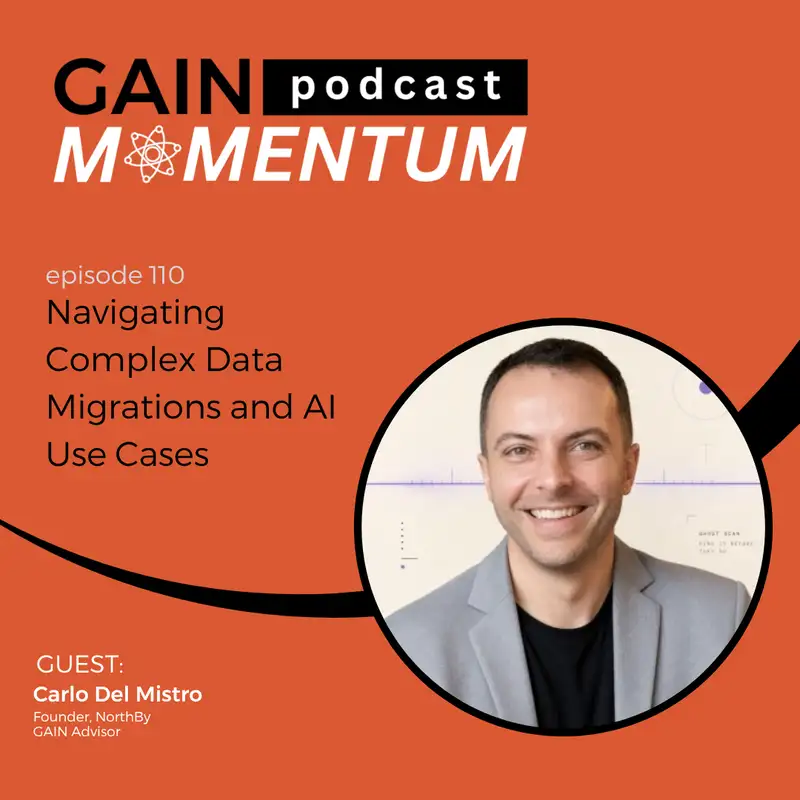
Navigating Complex Data Migrations and AI Use Cases | with Carlo Del Mistro
GAIN Momentum episode #110: Navigating Complex Data Migrations and AI Use Cases with Carlo Del Mistro
===
Adam Mogelonsky: Welcome to an exciting episode of the GAIN Momentum podcast. I'm joined by my co-host Vincent Somsen and our special guest today, Carlo Del Mistro. He's the founder of Northbay and a recently appointed GAIN advisor. Carlo, how's it going?
Carlo Del Mistro: Hi, Adam. Thank you for the introduction. It's pretty good, I have to say, the summer is already over here in London, so I'm just like, the usual gray gloom
Adam Mogelonsky: Oh, yeah. Well, I mean, but it is a hotbed of hospitality. There's a ton happening there. So to start off, tell us how you arrived in London. Give us some career highlights
Carlo Del Mistro: Absolutely. You know, throughout my career, I've been working at the intersection really of customer proposition and commercial performance, and I have this thread of technology that like sprinkles it over. You know, I started in Italy working in corporate strategy. I was in McKinsey straight out of uni, and then I started looking more into operation.
I moved to London about 20 years ago now, even though my accent is still pretty much fresh off the boat. However, my first experience in hospitality was with One Fine Stay. You may know the company. It's a peer-to-peer marketplace, acquired by Accor. You will see it's not the first time this happens in my career, but I was at One Fine Stay, and at the time we were really building this luxury peer-to-peer marketplace, and I was taking care of all the commercial side of the London market.
I then moved, and I landed in Premier Inn, you know, the large, budget, chain in the UK, 800 hotels, and that was really my first experience of hospitality at scale. It was like large listed company, and seeing how a company like that operates was a really eye-opener for me, and that it was where I was working really with technology.
It was about customer experience, what the customer needs, and building the app, building the check-in floor. It was really exciting.
I then moved, in 2019, to Ennismore, and Ennismore at the time was a founder-led, man- hotel management company. I was reporting directly into the founder, and at the time we were growing the Hoxton and Gleneagles as the two brands.
And I left in January 2026, and the company now is, part of the Core group. It's about an almost 200 properties, over 20 odd countries, 17 brands. And it's really, you know, the experience at Ennismore was amazing because it was the opportunity to bring together product and engineering from a technology side, but then also e-commerce and loyalty on the commercial side.
And it was, for me, you know, an experience of seeing what does it mean being brand led, multi-market, and using technology to really put everything together. Since I left, I've been spending more time doing advisory role by Norby, and I've also been building particularly around the space where AI and digital ec- execution can really improve direct revenue and loyalty.
Vincent Somsen: Awesome. Carlo, can you tell us a little bit more on, you know, why NSmore, you know, really stands out, you know, in the-- our core portfolio and in general as one of the most innovative, you know, brands in the hospitality industry?
Carlo Del Mistro: Absolutely. Ennismore describe itself as a collective of founder-led lifestyle hospitality brands, and here where the focus is, is really on the founder-led. What Ennismore does is involves the founder in the day-to-day of operation of their hotels, and you can really see that each one of the brands has a real personality, has a real brand, and really focus on that.
And the other area is that the lifestyle hospitality. You know, lifestyle hospitality is, what does it mean? It's like it's not only rooms, F&B is as important, but then especially it's about the brands, it's about the culture, it's about the community and the experience that, that, you know, are very central to what is, a, you know, a lifestyle hospitality hotel.
And then looking at the technology, Ennismore has always been a technology focus. When I joined originally in 2019, Ennismore already had a technology team. Before, like, we had, like, 10 hotels, and at the time it was a bit crazy having, like, engineers and pro- a CTO, product managers, et cetera, in such a company.
But, it's because, like, Sharan, the founder, really believed that we would not have been, as successful had we not been complete control of our technology and the, like, the user journey. So we build our own booking engine, we curated our website and online experience, and we really, like, managed to, set the voice, of the brand from the beginning of the customer journey.
Today, you know, clearly is multi-brand, complex, operation, and, from a tech- technology point of view, is a very different challenges from the beginning. You know, is, is about common platforms, it's about the data foundation, and anything else that comes.
Vincent Somsen: Yeah, and I can imagine that integration with Accor, a couple of years ago, that also brought some challenges and opportunities of course. Can you tell us a little bit more on, you know, the interaction with the parent brand and how that worked from a technology point of view?
Because that's a, it's a relatively uncommon, relationship what you have, you know, in the industry
Carlo Del Mistro: Yeah, absolutely. I won't be able to get into the specifics of the actual projects, because of confidentiality. They can try to keep it higher level and, you know, what is the principle that is transferable?
And I think the key there is, where can we leverage the group scale where it helps, and where do we need actually to protect the brand specificity?
Because the question is, you know, it's if the only thing that we do is integration for integration's sake, we forget why we put together like these brands, why we created like, Ennismore in the first place. You know, it needs to be an operating model decision, not just a technical decision.
For example, again, where does, scale really help? You know, data and data governance is like security, infrastructure, procurement. Those are like easy wins for scale. Distribution as well in certain areas. However, when you're talking about what makes Ennismore brands unique, you know, you want to make sure that the brand still control, you know, the content, the, the content, the commerce experience, the commercial strategy, membership.
I think you need to maintain enough flexibility. And actually, Ennismore has been very successful in this.
Adam Mogelonsky: So you talk about the scale of various systems, and of course, not to drill too far into the weeds with the Accor Ennismore relationship, but one thing that affects every single hotel is this whole idea of data harmonization.
And now you're dealing with different systems across hundreds of properties trying to bring that data together. How do you approach that problem of bringing different systems together so that way you can have a uniform source of truth or system of records for guests across different properties, different brands, different countries, et cetera?
Carlo Del Mistro: Absolutely. It's definitely one of the challenges, especially because, for example, for a company like Ennismore, but very often also for other companies, is about bringing together legacy systems that existed before the current, you know, corporate structure. And so, you know, it's about, like, the data, especially in hospitality, does not reflect just like, it's not data, it's data.
Data reflects the local processes, local system, regulation, habits, is SOPs. And so, you know, what I've seen both at Ennismore but also beyond Ennismore, is that you may have two properties using, you know, potentially a PMS from a similar vendor. However, you know, the definition of, you know, your KPIs, what is a guest profile, preference, segment stay, they're all different.
And then once you try to merge them, you know, it's not only a technical challenge that can be solved, it's more like a business challenge. So, you know, it's not only migrating from A to B, it's agreeing what data means. What is the quality threshold that we want to accept? You know, who owns data? Is it IT? Is it business? And, you know, and then there is big piece about the legal and compliance that is very important. So data migration is really a business transformation piece more than just an IT project
Adam Mogelonsky: Yeah, and I guess, a follow-up there is, you know, you mentioned this term legacy systems and, you know, as a prelude to your work in AI and your thoughts on it, it seems like every day there's a new system that's being called a legacy system. But you can't gut a hotel's IT stack all at once. You have to schedule these things. So what's your process and your philosophy around deciding that order of priorities for data migration?
Carlo Del Mistro: Absolutely. I think if you're focusing on, the systems, I think that is, identifying which is, what are the business requirements first and foremost, and then choosing via data like which is the right vendor, which is the right provider that you want to work with. Once you have selected the vendor, then it's where you start this project.
You know, working together between your internal team and the, you know, the vendor team to, set up the migration. And I think there is where the problems often start because it's about, making sure that the local teams that need to be involved have the right capability, the time, the prioritization to actually make the project happen.
And that's why I'm saying it's, it's a transformation project. It's very rarely data migration is purely technical. I think what I've seen, having done quite a few of these data migration, is that where the process breaks is not so much on the technical side. It is, it's transformation change management
Vincent Somsen: Yeah, that makes sense. And I imagine it's, it can be a challenge as well because you guys have so many, or Ennismore the brand had so many different owners as well of properties, with the asset light model that that's also slowly changing of course across, across the world. But, you know, how would you, how did you deal with that, with changing preferences and changing technology vendors all the time, right?
Carlo Del Mistro: Absolutely. and it was also for me a bit of a shock when I moved from Premier Inn, which owns or basically pretty much every single hotel to, you know, Ennismore or broader, hospitality players where is, management companies. And, you know, the reality is most owners respond to clear economics.
You know, if you can make your business case why an owner needs to make an investment, the owner usually responds, a constructive way. And the challenge is that very often the owners are reluctant to spend because, like, they do not understand the business case is unclear, the payback is theoretical, or the benefits seem to accrue more to the brand.
So for example, what I've seen very successful is that you have some owners which are more, excited about the change, and if you can use those owners to run a pilot and prove their side, then you can use that as a case study with other owners that may be a bit less open to do these kind of investments.
Vincent Somsen: Yeah. Okay. Is that also the advice you would give to, you know, startups or scale-ups that are looking to do business with larger hotel chains? Is that how it usually goes in your experience?
Carlo Del Mistro: Yeah, I think, what I've seen about the Premier Inn and then it's more of some of the companies I've been advising, is, pilots, especially in friendlier hotels, is where the upside is. You want to have an actual concrete example from within the network of an hotel that has seen benefits from a new provider, from a new technology before you can really sell it internally.
And, you know, how you set up the pilot is fundamental because you can have running pilots that are done properly and they actually have a, a, real impact, and you can have pilots that are badly run, poorly tracked, and actually that they don't really help. So I think if the pilot is set up correctly, that is like a huge win for anyone that wants to enter into a new customer.
Vincent Somsen: Yeah. How many out of, just an estimate, not specific, but out of the 10 pilots that you're running, for example, a quarter, how much of, how many of them eventually make it to a proper integration, you know, beyond the pilot?
Carlo Del Mistro: My experience is probably about, between 30% and 50% of pilots are successful. We have, you know, you may have a certain situation where the pilots are, are successful. However, you know, for some reason you decide not to go with the supplier anyway. But then I would say if the pilot is successful, I would say there is like a 70%, 80% chance of the customer going with it.
And as I was saying, if the piloting is not successful, very often it's not because the solution was the wrong solution, but because the pilot was set up poorly. So it was, you know, badly tracked, you didn't have the right people involved from a client side, and just like getting the momentum behind the pilot
Adam Mogelonsky: Yeah. Another part of this as well is this whole idea of a digital experience. So the, not just the backend systems and data migration amongst PMS, CRM, and loyalty, but also what the guests experience from a digital end, and largely that can be around the app. wherein through Ennismore and, I guess Accor and, and other experiences, you've had some experience with, with building apps and, and maintaining the content there.
So right now though, there's a problem which is being called app fatigue, where there's essentially too many apps for people to download and they don't want to get the app on the phone. So what are you seeing from the mobile engagement side right now in 2026 for guests, and how do you approach the issue of just having things available in a very clear, intuitive way for guests?
Carlo Del Mistro: Great question, Adam. I think the reality is that most guests do not need another hotel app or just like another app on their phone. So there is, you called it app fatigue, and I totally agree. I think the guest today is quite skeptical of a new hotel app, and they really need to have a reason to download it.
So to me, the question is, whenever like an hotel and operator is thinking about creating a new app is, what can the app do that is genuinely better than web, email or, you know, WhatsApp messaging or even like front desk?
I think apps work in two, you know, when they put together two, features, it needs to be an app that needs to, or feature that is used often, and it generates real utility by being in an app above being, you know, on a web interface.
So if, you know, it can be a great reason to have it, but if you only use it once, it's just a faff. So from my point of view, where it really adds value, the app, is that is there multiple services that you can bundle and make, identification and access easier?
So for example, there is now useful hotel apps, put together check-in, keyless entry, and when I talk a keyless entry, needs to be a good keyless entry, experience. So NFC, you know, do I need to, you know, can I use it without unlocking my phone? Can I use the app to ask a request at the front desk, upgrades, local recommendation, benefits?
I think that one is something that adds value. There's a lot different services that have a good frequency or utility, and I think like the membership is where there is actually a lot of utility.
You know, if you have a membership, you know, a membership proposition, loyalty proposition that is strong, customer are engaged, and then you can use the app to really be the home of this proposition about the discovery and repeat engagement, I think there is a lot of value.
However, if the app is just like a container for the website, then I don't think a guest will want to download it or use it
Adam Mogelonsky: Yeah. Well then the whole idea of the app brings us forward from, I guess, last decade or last five years to present day. Now we have AI and a lot of your work is around AI. So how is data and apps, if you want to include that, being shaped by AI across loyalty memberships, various types of rewards or personalization and overall engagement with brand?
Carlo Del Mistro: Yeah, absolutely. I think data even more today compared to just like five years ago is really like the lifeblood of an hotel commercial efforts.
And talking about data, you know, I think one of the misunderstanding that I see often when I consult with clients, also with my previous experience with some of my, my employers, is the misunderstanding is that you don't need a massive data lake.
You do not need a perfect, single customer view to actually start extracting value from the work you do on data infrastructure.
Today, especially thanks to AI, but also like with traditional methods, you can really, make a difference that is seen in the bottom line by using, you know, just a tidied and structured data.
For example, take the CRM. Very often when you're like in bigger groups, you have, you know, CRM data, which is, there's a lot of duplications, it's messy, there's different sources, it's not very well used.
Just cleaning up the CRM data properly and using data to, you know, save a customer that is lapsing, sending relevant offers, helping with, the, dealing with the commercial, pain points adds a lot of value, and it does not require massive investments.
Then once you get started with data and with cleanup and you see the real bottom line impact, then you can become smarter and better. But I've seen a lot of companies that are like freeze in place saying, "We cannot do anything about personalization or customer engagement because we don't have the single customer point of view."
Guess what? I've seen very few companies that have well done single customer point of view. It's, you know, an ideal, the arrival point, but the journey that really matters. And-
Vincent Somsen: That makes sense. What have you seen as one of the most, inspiring use cases around that? So personalizing a guest journey, whether that's in one of the previous employers of yours or what you've seen in the industry
Carlo Del Mistro: Absolutely. So this is very interesting. So what I've seen personally as great personalization is actually like, especially if you look at the luxury, and lifestyle, is about personalization at the service level.
It's about providing the front desk teams information at their fingertips to make the arrival and the stay experience, exceptional for the guest.
And this is, again, something quite basic. It's about ... A lot of it is about UX. It's about how the information gets raised to the front desk. It's about SOPs, which is what do we actually do with that information? What is the front desk required to do?
And that one is, something as simple as recognizing the guest and being able to tell them, "Ooh, welcome back," versus like a welcome, "Have you ever been here?"
It's about remembering the, like, the favorite cocktail or some setting. You know, the guest always wants a certain type of pillow. They're basic, They're the basics, but they're the basic of hospitality, and I think, like, to get ... Hospitality is about getting, first and foremost, the basics done well, and I think that already helps you, and then you can have surprise and delight.
On the digital side is about the personalization of the journey. So for example, one of my clients, we're discussion now about can we personalize the checkout flow through the booking, reflecting, what the customer is looking for?
For example, if a customer is looking for a stay with two adults and two children, can we change the content of the booking engine to showcase, you know, children out by the pool or families having dinner, et cetera, versus somebody who's, like, a business guest, a single booking, like a single person booking midweek.
Don't show them the family having dinner. Show them, like, something a bit more, like, for single business traveler. So it's not extremely complex to implement. You don't need, like, the whole data architecture to be in place. It's more about what can you do and what can you actually ... You know, what data you can you get, and what can you do with that, and why does the customer care?
Vincent Somsen: Yeah, that makes sense. And I think from a competition point of view, I mean, Booking.com, they do 1,000 A/B tests a day, right? So it's, you know, to personalize a journey whether a button is yellow or blue or red, you know, that, it has a huge impact on that journey, whether you personalize it to that extent or not. So that's interesting.
And what you said about the CRM and having a kind of a golden profile of a customer is super important as well to drive those direct bookings, right? You can invest millions and millions in your website and maybe have a beautiful photography and, still mess it up, when, you know, somebody has to log in for the, for the 20th time and doesn't see its previous taste recognized and already spent tens and tens of thousands of dollars, so yeah
Carlo Del Mistro: or you can say, you know, loyalty, because like checkout flows optimize completely, but then having the loyalty step that breaks the journey and forces you to become a member and then sends you back at the beginning of the journey. You know, there is a lot in doing the basics right. There is a lot of insight, there is a lot of opportunities, and really a differentiator as well
Vincent Somsen: Yeah. Well, I remember that, having that problem about a decade ago. I was working at the W in Amsterdam. We were doing a pre-opening, and this was still part of the SVG portfolio, the Starwood portfolio, right?
And we would check in these, these consultants at one of the larger firms in Amsterdam, and almost every time, they would come every week, right? It would say it would have a new reservation with no loyalty program, and you would have to log into SVG and match and merge the loyalty programs, and just feel that hasn't improved.
You know, even though we have so many tools and so many AI tools and that can done it in, do it in the back, and maybe the technology is there, but what you're saying earlier in the conversation, the human aspect and the operational transformation is, it's very hard for hotels to implement
Carlo Del Mistro: Absolutely. That's where there is, I think the biggest AI opportunities, at least today, is actually taking over repetitive, high volume, high friction processes. You know, as you mentioned, administrative processes. You know, what does the front desk need to do that can be automated?
It's about content production. You know, you mentioned Booking.com, but even like, smaller, Booking.com is a huge, but also like a smaller hotel company is just about creating ads, creating ads variation, posting them. That one is a lot of repetitive high volume work that can be improved.
It's about customer service knowledge management. You know, how can you use AI to support, the front desk, of can support the call center to deal with the customer inquiries? And there's a lot of value there, and it's, as again, as we were saying, it's not doing things that are completely new. It's just doing the basics well, and then once you do them, you can improve and you can do more and really wow the customer
Vincent Somsen: Yeah. And, you know, in your experience working with external parties, you know, outside of the, outside of, you know, the brands that you worked with, was it a positive experience? Like, you know, I'm not going to pitch, you know, GAIN here, but we did do, an, you know, an assessment for one of the, one of the hotel groups in the UK.
And what we discovered, one of the first discoveries was that within their brand.com website, and their booking engine, you could book different hotels around, around the property that you were looking for within their hotel group. So, you know, something that they didn't discover themselves, but hugely important, by involving an external party, right?
Have you had any of, you know, those experiences, or did you do everything in-house, back then?
Carlo Del Mistro: I've had, very recently, an hotel company updated their, mobile journey, and they saw the conversion of a customer on Android mobiles basically going to zero.
And then it took a few weeks to figure, to realize there was this issue, and then, investigating the issue, and the solution was simply like the cookie banner was covering, the book button, and the cookie banner on Android, was not dismissible.
So yes, the visiting it on Android was not able to cancel the booking banner, and apparently nobody tested it. And, to your point, is something that, it's easy to spot once you know what you're looking for. But, you know, in the day-to-day of an hotel operation, there's so much going on. The teams are, small, and they're full of things to do, and then it's easy to miss
Adam Mogelonsky: Well, hold on, Carlos. So let's diagnose that problem because nowadays in mid-2026, one might say, "Oh, can't we just use AI to do those sorts of tests for us?" But then on the other hand, you say, "Well, an AI doesn't look at a screen the way we look at a screen when we're getting our, quality assurance team to test responsively across Android, Apple, tablet, desktop, et cetera."
So how would you learn from that specific issue so that way there's at least the QA in place, so that way if a bug like that does come up, you can fix it moment of before you do a live, a live release?
Carlo Del Mistro: Exactly. And this is extremely relevant because it's one of the areas that I'm particularly focused on, with some of my clients, is about using AI and using synthetic guests to identify these issues, not after weeks of missed bookings, but identifying these issues the moment they go live.
Traditionally in hotels, but also like in generally in e-commerce, you use tools that allow you to look back and seeing where did the journey break. However, because of volumes, you need to have hundreds, if not thousands of broken journeys to really spot where the issue is. What you can do today with AI is actually creating these synthetic guests, send them across your booking journey end to end, click around, find certain information, and understand where is the issue.
For example, you know, if you need-- depending on the hotel, but if you need an hotel, do you explain if the hotel has parking, checkout times, et cetera, et cetera. There are certain basics that are very important for a guest to see, to discover, and very often they are either difficult to discover, they're forgotten, they're wrong, and it's one of the reasons why then the guest goes to buy an OTA versus doing direct, because like the information OTA's is very well structured, and they force the hotel to structure in a certain way, and they will not allow you to go live with your listing without the information.
Whereas on your own website, it's easier to forget. You can actually get penalized by, ChatGPT and Gemini and all the other LLMs if you do not provide that kind of information. So your visibility is lower if you don't answer, you know, your site is not able to answer those questions.
Adam Mogelonsky: So this whole idea of synthetic guests though, would you say that it helps to level the playing field with the OTA's?
Carlo Del Mistro: Absolutely. I think now we are in one of those disruptive times where that comes probably once every 20 years, where, you know, 20 years ago or so, there was the rise of the internet and the OTA's, the change of the way like people book the journey.
Today, there is a similar shift that is happening because of like the explosion of AI and AI agent. And I think right now what is happening is really about the discovery, and the discovery of the hotels, the discovery of, experiences, location is more and more happening via, AI agents.
It's something that is, starting from a low base, but you know, from what I've seen, it went from the beginning of 2025, where it was like less than 1% of traffic to hotels going directly via, LLMs. Whereas at the end of 2025 was already like on the 3% to 5% of, guests, or visitors to the website were coming from the AI agent.
And what I've seen, what I like some data shows, is the propensity to book of those guests is double the propensity of booking from a traffic coming from Google or coming from another search engine. Because the people that are arriving there and they've already done their search on ChatGPT or on Claude, and therefore, when they arrive on the website, they are higher value compared to generic traffic
Adam Mogelonsky: So that changes the entire marketing funnel
Carlo Del Mistro: It's a moment right now where independents or smaller groups have a chance of gaining back, you know, distribution or gaining back market share from the OTA's is an opportunity for a nimble challenger brand to move faster than the big, massive listed companies because simply like they can move faster.
And also AI is probably one of the first times of that happens in technology where you do not need a massive budget to start seeing the benefits. You know, when everything moved to cloud, you needed millions to really embrace cloud and, and the system and it was complicated. You need a expert, et cetera.
Now AI is a very low barrier to entry and you can actually gain value already like at a low level. And I think that's where, you know, if a challenger brand that really puts their head up to it, they can really get a lot of benefit from the change in discovery, the change in distribution, the opportunities for moving faster
Vincent Somsen: Makes sense. Talking about moving faster, Carlo, what do you think about hotel chains, or even independents building out their own tools, right? Maybe fine coding their tools with, Claude or Lovable or any of those, Codex whatsoever. Adam
Adam Mogelonsky: And, yeah, and also saying this in the context of the recent Claude Code, data breach. So let's take that into account, Carlo
Carlo Del Mistro: Yeah, absolutely. So from my point of view, hotel groups, unless they have a proper technology team, should be cautious in going down the vibe coding route. I think if it's internal tools that don't touch customer data, that can are purely used internally for processes that are repetitive and that, that they can gain advantage, by all means, I think it's a great opportunity.
However, to your point, there is a risk for an, you know, a vibe coder to really touch customer data, payment data, and, very often the challenge is just like a maintaining those tools, because if you send a tool in production, it's not about like you send it in production and then you forget about it.
You need to patch it, upgrade it, make sure that it still works. So to me, where the opportunity is for, you know, challenger brands is taking advantage of this ecosystem that is now exploding of, AI tooling providers that can really provide a much cheaper and faster, and to be honest, new features compared to what was available before.
So, you know, the type of, we're mentioning CRM, I think like it's, CRM is a big opportunity for disruption. I think you're, you know, if we're talking about distribution, there is a lot of tools that can help, establish hotel brands to be smarter in the way they distribute their availability, in the way they price their products, and I think there is a big opportunity.
If we're talking about disintermediating your PMS provider, oof, I think that one is probably something better left to
Vincent Somsen: Yeah, it's open heart surgery. So what we compare it with, right? I think my last question, from a PMS point of view, or in general your hotel stack, are you more of a fan of all-in-one tools that are bundling, you know, three, four different features or solutions in one? Or is your opinion, the contrary, saying, “Hey, we want a best of breed and, you know, different, a lot of different technologies, and different integrations,” making it a rather complex system?
Yeah, what is your, you know, preference?
Carlo Del Mistro: Great question. And my answer, I'm gonna be hedging it. I think is depends. If you're a small operator with one to five properties, you probably want to go with the simplicity. You know, one tool that covers all your needs is probably the easiest way to get started and to manage your portfolio.
However, as you grow, as your requirements becomes more complex and you understand really what you need, I think that's where the modular approach or the, you know, the composability approach is where there is really a lot of power. And so it depends really on the size of your business and, you know, the complexity of your customer needs and the skill set of your team
Adam Mogelonsky: Yeah. I'm personally always a fan of the all-in-one, and my follow-up there is to go back to the whole idea of data migration, and what are your thoughts on how all-in-one can help with the data migration to have those, those use cases, that personalization, the mastering of the basics? How do you frame that when you're discussing that with hotels?
Carlo Del Mistro: Yeah. I think the beauty of an all-in-one system is that really there you don't have to worry about the different system to talk to each other. I think that is where the real strength of the all-in-one solution is that out of the box, or as close as you can to out of the box, you can get your PMS, CRS, CRM all talking to each other, and the customer really has, you know, a smooth experience.
And I think where the real-- And I think this is where, for example, tech vendors and, you know, tele operators really need to think about. It's not so much the beauty of the solution for the operator, it's more about what can you achieve from a consumer point of view. What does the guest sees? You know, the guest doesn't care whether you have an all-in-one solution or if you're using 10 systems.
What the guests care about is that the loyalty membership is a seamless integrating with their experience. They want to see the journey online already recognizing them as a repeat guest and therefore already tweaking their experience to reflect what, you know, their previous stated preferences.
I think that is where, you know, you can do it very easily and very powerfully with an integrated all-in-one solution. And I think to me, that's where all-in-one solution really shine.
And I think from a guest perspective, it's a bit like a of magic. In, in one of the clients I was advising, one of the challenges was, you know, they had, this loyalty just created this new loyalty proposition and, the guests were complaining that, once they were at the hotel side, everything was beautiful and personalized.
As soon as they moved to the restaurant side or the spa side, the restaurant team and the spa team had no idea who they were and why they were there, because the system was, was not talking to each other
Adam Mogelonsky: Yeah. So Carlo, to finish off here, you know, we've talked about AI, data migration, all-in-one systems, mastering the basics as the underlying, I guess, operation trend. What other big hotel tech trends do you see and you're excited about?
Carlo Del Mistro: Ooh, beyond AI, I think there's probably three areas that I think, is, is, they're quite exciting for me.
First of all is, The payment side. Payments historically in hotels and hospitality have been painful, has always been an afterthought, and I think now with the new generation of payment providers, it's very easy for hotels to offer first-class payment experiences.
For example, think about payment methods. It's hospitality and travel for a business. It's all about people from all over the world coming over and experiencing, different countries. It's historically quite close in terms of the payment methods that are accepted.
So for example, if I'm coming from even just like Italy or if I'm coming from Belgium, I'm used to use payment methods that are maybe not offered by my London hotels.
If I'm coming from China, I would love to use WeChat or UnionPay to do my payments. And so by offering a variety of payment methods, by offering a buy now and pay later proposition, you're really making your product more appealing to a wider selection of customers. I think that one is happening today.
There's a lot of value, and not only on conversion, but also on data. Because, for example, where a lot of data breaks is the hotel knows me. When I go to the restaurant of the hotel, I-- if I don't put my bill on the folio, very often the restaurant has no idea that me, as a guest of the hotel, have actually had dinner at the restaurant.
However, you can now integrate, in a smart ways your credit card to be effectively assigned to you as a person, and therefore the hotel has a much better chance to know that even though you didn't register as a guest at the restaurant, they can figure out the credit card used to pay was actually your credit card and therefore we can still connect.
That one to me is probably the biggest opportunity because it's massive.
Second, I think is making hotel retailing better. What I mean here is about e-commerce. E-commerce in hotels is still pretty stuck in what e-commerce was 10, 15 years ago. Personalization is low. Booking flows are stale. We ask a lot of information.
We make it very difficult to book a room and to go through a payment flow, sorry, booking flow. I think there is a lot of opportunities, upselling, cross-selling. There's a lot of opportunities that today the hotels are not really leveraging. There is more tools and opportunities for hotels to do better.
And probably the last one for me is, This one is probably a bit more connected with AI, but it's about the content operations. You know, very often content is a bit unglamorous within the hotel, but it's very important that, you know, the quality of the content, translation, which languages do you support, the structure of the content. There is a lot that can be improved, and I think now with there are tools that help hotels to really get their content to shine more.
Adam Mogelonsky: Wow. That's a lot to think about, Carlo, and, you know, definitely almost another podcast, but, you know, with AI things may change in six months and we'll have the content situation solved.
Carlo Del Mistro: Absolutely.
Adam Mogelonsky: So Carlo, can't thank you enough for coming on the show. It's been a fantastic and very powerful 45 minutes. Tantissimi grazie. Tantissimi grazie
Carlo Del Mistro: Grazie Adam, grazie Vincent
Vincent Somsen: Ja, tak det er mildt.
Adam Mogelonsky: Thank you.