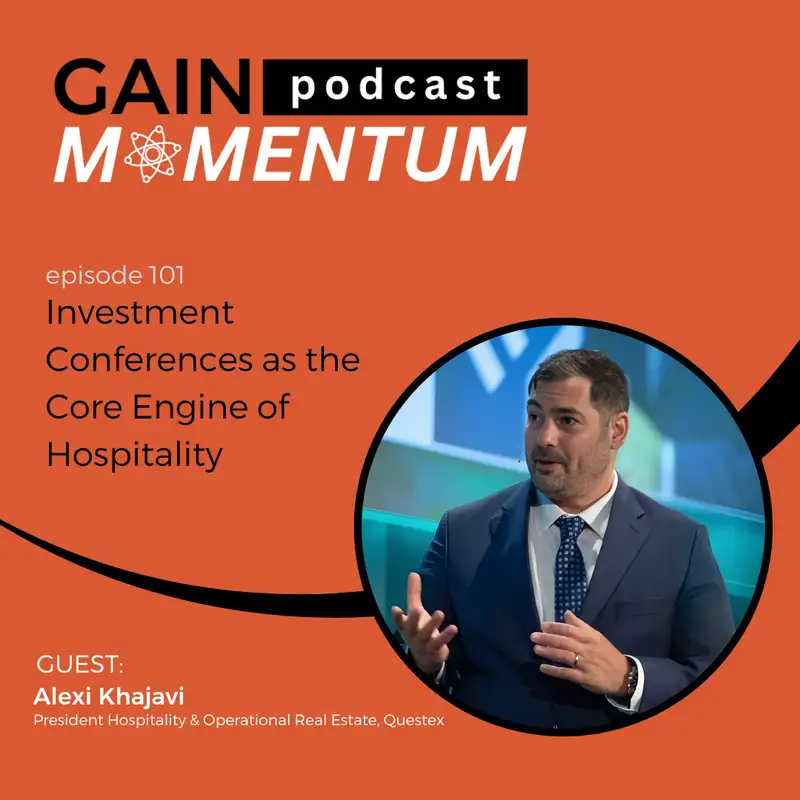
Investment Conferences as the Core Engine of Hospitality | with Alexi Khajavi
GAIN Momentum episode #101: Investment Conferences as the Core Engine of Hospitality | with Alexi Khajavi
===
Adam Mogelonsky: Welcome to an exciting episode of the GAIN Momentum podcast. I'm joined today by Alex Khajavi. He's the Group President of Hospitality and Real Estate at Questex. Alex, how are you?
Alexi Khajavi: I'm good.
Adam Mogelonsky: It's great to have you on because Questex has a very important role at the Center of hospitality and at related, parts of real estate.
So to start off with, give us the elevator pitch of what is Questex and what is the totality of, what it does.
Alexi Khajavi: Yeah, Questex is a information services company focused in B2B, and we are focused on three broad markets. but a very defined market. one is life sciences in healthcare. The other is experiential technology, and then is the broad market, what we call living, with the submarkets of hospitality and real estate as a part of that.
And essentially we do, the same thing across all of those markets. We connect. Inform buyers and sellers, the professionals that work in those industries. we'll provide research information, editorial news, and then ultimately we're trying to drive those buyers and sellers to our live events, so that they can, engage, network, learn from each other, and ultimately drive that market forward.
Adam Mogelonsky: Yeah, I, like that word connect because the core of it is the conference, the trade show, the event, but then there's this whole year round cycle of continuous education and networking and the. General cross pollination of ideas that helps to bring people together and make that a continuous process. So your bailiwick is hospitality and real estate.
So what is covered within that?
Alexi Khajavi: Yeah, so there's submarkets within, the broader market of living. So in on, starting on the hospitality side, we are in, what we call hospitality management. that is, Working with professionals that work within the hotels, bars, and restaurants. and ultimately those range from an owner operator, a franchisee of a hotel, to a food and beverage director, a housekeeping director, ahead of, housekeeping, general managers.
So any role or head of procurement that is within the operations and those individuals are making purchasing or procurement decisions on. Products and services that go into running, bars, hotels, and restaurants. So that's the hospitality market. we're then in the hospitality market from a real estate perspective.
So we're, we've got a portfolio of hotel investment forums, Europe, Asia, and the us, where we're connecting the owner of the real estate. With the operators, the brands, the third party management companies, all of the professional services from advisory to valuation, to feasibility brokerage, and into f and b consultancies, and other, aspects that go into how to operate those hotels on behalf of the owners that own the real estate.
And then the other side of our real estate market is really truly the living, versus the lodging side. And that's really focused on multifamily and affordable housing. we're really well embedded in both hospitality and real estate. The real estate that we are, serving and the professionals, in the certain asset classes that we serve, range from hotels.
To multifamily, to affordable to student housing and senior. So it's a pretty broad but focused, approach to both hospitality and operational real estate.
Adam Mogelonsky: It makes sense to have that, mix because we are seeing a lot more mixed use cases. This is a hotel podcast. We are seeing a lot more mixed use, whether it's hotel plus commercial, hotel plus multifamily via branded residence or otherwise. and even certain categories of hotels crossover into student housing and senior living.
So yeah, bringing that all together is, monumental.
Alexi Khajavi: Yeah, it's really what we're so excited about. we've been deeply immersed in, really the more the hotel investment side for the last 25 years. and it was really only last year, where we acquired a portfolio of multifamily and affordable housing. Both of those asset classes are, frankly, dominant, asset classes within the overall commercial real estate, market.
each of them have their own sort of tailwind dynamics. residential, housing is, at a huge, under supply in most major markets and certainly, most cities in the US but also in Europe, Asia, and other parts of the world. So in and of themselves. just sticking within those asset classes is a huge amount of demand, and under supply, and just a massively fragmented market with a lot of, opportunities in and of themselves.
But to your point, one of the things that we're truly excited about is that we're seeing a blending of the asset classes. multifamily particularly, the younger generation is not just looking for a, an apartment to rent and, it's a monthly, lease that you pay or rent to the landlord.
but they're looking for amenities. they're looking for co-working, co-living. they're looking for a gym. They're looking for a cafe. They're looking certainly for wellness. they're looking for, concierge like services depending on what, part of the market, you're in. And all of those are what hotels do on a daily basis.
So the service and the Amen and the hospitality component is finding its way more and more into the multifamily asset class. And to your point, you're also seeing hotels take on longer extended stay service apartments, hostels to a certain point. You're seeing mixed use, particularly in some of the emerging markets like Asia, where, you'll find a highrise tower, where the first, 15 floors, the street plate is retail.
You then have, floor one through 15 as, A hotel, you then have student housing at the top, senior living in the penthouse or maybe, but you're seeing this mixed use really come into, an adaptive reuse, perspective, particularly in the emerging markets. So there is a really exciting blend of asset classes that we, that we're really at the forefront and the vanguard of, and we're seeing a huge amount of capital.
Go from hotels into rei, we're seeing capital go from REI into hotels or hospitality. But you're also seeing then the operators and the professional services, follow that money into that, that diversity of, of asset classes. So it's a really exciting space to be in.
Adam Mogelonsky: Yeah, I, love that you used the term, amenatization. That realistically you could do a Google search that didn't really exist as a word three years ago, five years ago, and now it's, everything is about humanization. So my follow up question without going too far into the, weeds of. your silver ball, but why now?
For why is this blend happening now? Full steam in 2025, 2026 and not 2016 or 2015?
Alexi Khajavi: I think like any market, markets in of, in and of themselves go through maturation. So they mature, but they also go through life cycles. but at the end of the day is a customer. and so even though we're a B2B platform, meaning we're connecting professionals and businesses within the markets in which we serve, at the end of the day, there is an end customer.
And that could be a, B2C at some point. and in the markets that we serve, there is an end user. Could be. Could be an individual renting, an apartment could be a student, going to university for the first time. could be, an act of living, a senior, that's looking to move out of a single family home into, one of these, one of these asset classes.
for us. it really, comes from the end market. we are a omnichannel 365 day engagement platform. So we have 6 million records, individual records of professionals that work in the, in each of the industries in which we serve. We publish every day. We, we produce, news, we've got newsrooms, that are constantly talking and tracking, the professionals in the industries in which we serve.
And then we're monitoring, their engagement, what stories they read, what sessions they, participated, what research they downloaded. That gives us a huge wealth of information, not just once a year, because we see them in New York at the New York Hospitality Investment Forum. We see them, every day on our sites, opening our newsletters, engaging with our evergreen research or content.
And some of the things that we've, noticed and we started noticing them really, in 21, 22 was that, two, two things to specifically answer your question, Adam. One is that investors, institutional investors. We're engaging more with how to run hotels more profitably. and, what we've seen is that is somewhat of an indication of, supply chain issues, inflation, labor issues.
But there's a huge challenge. it's much harder to run a hotel profitably, today than what it was just, five years ago or 10 years ago. institutional capital as well as franchisees, which are. Often owning and operating that hotel asset on behalf of a brand. they are much more engaged in how to drive value or net operating income from the operations of that hotel versus what was 15, 20 years ago.
less, I'm just gonna sit back and let the real estate appreciate but let somebody else operate this hotel. On my behalf. So that was point data, point number one, which, we absolutely got, that data captured that data, and extrapolated that insight based off of our ability, to engage with the audience 365 days a year and understand what their behaviors were, what their interests were, and really then turning that into an intention.
Then the second one is that we are seeing just a huge, amount of, transformation in that capital that was only dedicated to resi is now allocating more funds to hospitality. and some of that is just. Just based off of very nature of what hospitality allows for, an operating business to do, you can reprice on a daily basis.
you can really capture market trends, consumer demand, It is as capital chase's yield, hospitality, and it, and I would include residential in there, is a really, is a value add dominant strategy rather than core. So you're buying not just the existing asset within its existing framework of how it does business, but you're buying into the value creation that's left undone and you know that capital is chasing that value add.
That's where the, yield comes from. Is by driving alpha or sweating the asset by operating it better. And, that really for us as a platform that, at the end of the day, we inform and we connect. that means that there's a lot of regeneration, there's a lot of investment, there's a lot of new technologies and a lot of products and services that are coming into this marketplace.
that's driving a lot of market movement. that's good for us. The professionals in the industry need to constantly, to your point, Adam, stay educated, stay up to date, know what the trend lines are, know where the challenges are, understand best cases, or lessons learned. So really that, that capital allocation, that, appreciation by capital to, create value within their assets, through operating the business better.
all of that. Is, is demands more and better education. It demands connectivity, and at the end of the day, that's the business we're in. So we're just catering to that demand.
Adam Mogelonsky: Yeah, it's almost like the data that you have from your engagement is a leading market indicator in terms of where things are going.
Alexi Khajavi: A hundred percent. it is a beautiful thing for us to be so deeply immersed in the markets that we're in, because in many ways the data that we get. is critical to the businesses in which we serve. so for example, we just came out of Berlin where we had our IHIF emea, which is a HO hospitality investment, event, running for 26 years.
we do a quarterly survey of the world's top 100 investors from our investor council. and then we do a pulse survey, which is when we're at the event we engage with those investors. We had 700 capital equity investors ranging from sovereign wealth to private equity to high net worth individuals and family offices.
So 55%, of the investor community, is looking for a value add dominant strategy versus 9% core. So again, these are value creation investors. 62% rate, European gateway cities as the high opportunity. 41% are increasing their, hotel allocation. So they're actually investing, deploying more capital into it, and 72% are shifting, Opry capital into hotels.
So really hotels are, the bell of the ball, so to speak. and that's partly because so much capital has been raised, but it's been. Been a pretty slow investment transaction market. Interest rates have been high, geopolitics have been raging, so it's not been an easy market in which to get deals done, but as interest rates have declined, and you're starting to see some ma maturation of debt and CMBS loans, particularly here in the us, we do expect that transaction market to pick up, hence why we're doing so well in terms of pacing for the NYU event, which is, June 1st and second, here in New York.
Adam Mogelonsky: So let's shift gears and talk about that. I-H-I-F-N-Y-U or in New York, beginning of June, every single year. This for everyone who hasn't attended it is the pinnacle of investment events in North America. At least you could make the argument for the world. But then, you're talking about other IHIF's, the one you mentioned in Berlin, and then, the other one in Hong Kong, I believe.
So IHIF NYU give us a sense of how big it is and, attendees, what's discussed, composition of who's going
Alexi Khajavi: Yeah, so to your point, NYU, has been operating for 40 years. was started by the School of Professional Studies, the Tisch Center of Hospitality. John Tisch has been, supporting the university, and is the chairman of that event, for, for many years now, and continues to be, involved.
It is the most international. Investment forum to New York Financial Capital of the world, gateway City to the world's largest hotel market. and home of, the world's largest investment banks, retail banks, advisories, and everyone else in between. you've got, Marriott and Hilton, just a, an hour train, ride, in the Maryland area. So really, we're, blessed to be in, frankly, one of the most financial capitals of the world. Clearly, NYU has a prominent place within that, that ecosystem. and to talk about the size and really more, we're focused more on quality, to be honest with you.
that being said, 2,500 attendees, about 25% are equity investors ranging from, your big names of Blackstone, Brookfields, and, Apollos to, family offices coming in from Asia and sovereign wealth funds coming in from the Middle East, in Asia. So it's a really diverse group.
the primary audience, are those equity investors. That's. Who we cater to. those are the, the primary, buyers. There's, they're the ones that are, transacting on hotel assets. And the transaction, or a development of a hotel for that matter, is really what kicks off the entire market, right?
You, need brokerage, you need legal, you need, tax advisory, you need, architecture and design. So all of those professional services, really come into play, particularly around a transaction. And the quantity and the, the, density of capital, on the first and the 2nd of June is bar none.
it's really where, the entire hospitality investment market gathers. All of the major global CEOs from the brands were there. From Marriott to Hilton, to Hyatt to aco I HT Wyndham Choice. And then the heads of, all of the professional services from investment banks to brokerage to advisory are all there as well.
It really is a, a who's who of the industry, and they're there to learn, but really to, to do deals. and, there's nothing better. I, we don't track, specifically what deals are done, at our events because we, look at it as a 365 day engagement with the audience.
But there's nothing better than, and, in fact, we just heard. I think it was a week ago or two weeks ago, a major deal that had, has already been announced, was, consummated, at NYU last year. And it, took months to, actually come to market and for that deal to get done.
But that connectivity was made, at NYU, on both the sell side and the buy side. and, that's really what we're here for. We're here to, educate and inform. a knowledgeable market is a more efficient market. We know that, but at the end of the day, it's a marketplace and people are there to do deals and most importantly deals are getting done.
Adam Mogelonsky: Yep. it's a very, Brian Tracy of you, the sa, the salesperson where you know, nothing gets done until there's a sale, right? This, yeah.
Alexi Khajavi: Yeah. to your point, not to get Glen Gary Ross on but, look, at the end of the day, it does come down to the deal. that is ultimately why, the best brands in hospitality or in multifamily or in affordable housing, do business with us because we bring.
The right buyers of their products and services to the table. we do it in a very high quality way. we're highly curated, in making sure that they're getting the meetings they want, and that deals are happening. we can't influence interest rates. We can't influence geopolitics, or the macro economy for that matter, but.
this is the world's largest industry. and if COVID taught us anything is that people are gonna travel. and therefore, in a volatile market like it is now, actually running a hotel where you can reprice on a nightly basis, you can quickly adapt to trends and customer demands.
That's a good place to be. There's value creation, as we talked about a few minutes ago in that asset class. And so to a certain extent, despite the macro economy. There's a huge amount of capital coming into the space and QuestX is benefiting from that. But we're also very pleased to be to connect the right professionals in this.
Adam Mogelonsky: And with that, you mentioned 40 years and just being the facilitators for all this transaction volume and deal flow, there is a mantle of responsibility. You inherit coming in and leading this division of QuestX. Can you talk about what's involved in terms of facilitating this event and keeping it as robust and as, as critical as possible?
Alexi Khajavi: We have to give a lot of credit to Questex as a whole. we are, we are structured, in the same way across each of the markets. so in the markets we have, sales marketing. Content, that are deeply embedded in their respective markets. They, in many cases, have decades of experience in relationships, and they're building the strategy.
They're understanding what the challenges needs and wants of the buyers are, and then they're effectively creating experiences, products, marketing services, lead gen, promotional awareness opportunities for the sellers in that market. To effectively inform and connect with their buyers. you know that is, and, that's the same US housing or living as it is in beauty and wellness as it is in life sciences and healthcare.
it, we have incredible talent in each of the markets in which we serve. Then each of those market teams, sit on what we call the centers of excellence. and that's really the engine that drives the, Questex, company as a whole. And in there lies audience. So we have 6 million individual records.
We're consistently engaging with those records. We know it's fresh, we know they're engaged. We know, where they work, what they read, what sessions they engage with, and we're constantly capturing that data. We have performance marketing, so you know, we are a world-class marketing organization that can help our customers connect to the buyers in each of our audiences.
Everybody's different. somebody might need, promotional or awareness around, a product roadmap that's coming out next year. somebody may want deeper down absolute lead generation and, lead scoring, from a highly, small but defined cohort. others are trying to target resellers in their respective space.
And again, that strategy is sorted and, extrapolated by the market. It's then we in the market work with our COE to determine how can we serve that market better. and then of course, we've got event operations. we are probably one of the best in operating, whether it be a small boardroom meeting at a JP Morgan breakfast in San Francisco to, a trade show of, 40,000, beauty and wellness, operators.
So we, we have this talent that is functional. Across audience, MarTech, performance marketing, event operations. and then we have the markets which are verticals which sit on top of that foundation functional expertise. And really that's the success is our structure, number one, the strategy that the markets are able to develop because they know their markets so well.
And then like any business, it just comes down to the people. and we're really blessed and very fortunate to work with some of the best and the brightest, in information services companies. And that's, it's not rocket science. it's just a lot of hard work, but, but at the end of the day is very rewarding.
Adam Mogelonsky: And speaking of hard work, probably the big one that you have to assemble is that CEO round table at I-H-I-F-N-Y-U, where you're able to somehow get. Six, the top six CEOs for the top six hotel brands on stage at the same time. no matter the geopolitics, they're always there. How do you make that happen?
Alexi Khajavi: It's because their customers, the most qualified, active investors of hospitality real estate are in the room. primary. So they're speaking to, the investment community. We also have over a hundred, international press and media there, ranging from CNBC where we've got Sarah Eisen on from Squawk Box, that comes up and moderates the, the CEO panel.
So in many ways it is also the opportunity for them to discuss. their strategies, what are they doing from a global perspective? Where do they see their, opportunities in terms of future growth, for their respective businesses? and that's, hugely important to publicly traded companies.
and then at the end of the day, it's hospitality. For the most part, and I would say overwhelmingly, the people that work in hospitality are some of the most gracious, open, sincere, creative, and, happy to share, their opinions. Because they're well traveled, they're well educated.
they, work up and down from strategy into the operations of delivering an incredible experience that it's really interesting. I I'm biased. I love the hospitality industry. It's not a static industry. It's constantly changing. It's highly fragmented. It ranges from understanding macroeconomics and geopolitics to being able to read a, p and L, to doing the daily ledger, to what are the customer trends that are changing how hotels are built or designed, or operated.
there is no end to what we could talk about, and honestly, the professionals in the hospitality industry are really some of the most interesting people that I think are out there. it's really not hard from that respect.
Adam Mogelonsky: I love how they can all speak so eloquently up on stage and, even drilling down to specific opportunities or experiences they had, whether it's. In some emerging market in the states like Utah or even to Nepal or something like that. And, meanwhile, all I'm thinking of is you know, their, loyalty status on all the airlines.
That's, what I'm just thinking about because clearly they're just traveling all the time across the world,
Alexi Khajavi: I would venture to say a few of them, are not on a commercial airline with,
Adam Mogelonsky: right? Yeah.
Alexi Khajavi: but yeah, I'm always just, absolutely impressed by, somebody just got back from India and they're on stage and they're holding, 12 hours of meetings and doing, doing a, a press conference, or, going down to Wall Street and doing, an interview on, on CNBC.
these are some of the hardest working, most, I think, passionate people for what they do. and it runs not just from the CEOs of the brands, but it really runs across the industry. It's, we're very proud and privileged to be able to, to serve the industry.
Adam Mogelonsky: right now for context, we're recording on April 21st, 2026, and we've mentioned the term geopolitics. the supply chain, second order, third order for fuel shortages around the world is hitting markets very as asymmetrically, particularly with some islands now facing jet fuel shortages where they physically can't get guests to the islands.
And a year ago, some emerging markets may now look term. So how has the current geopolitical event impacted your role at Questex and just the facilitation of this event?
Alexi Khajavi: It's been a rollercoaster ride, right? it feels like every day is a, new, news announcement or, it's just been one thing after another. Other, which, a very, active investor said to me a few months ago, we can pencil in risk. In fact, that's our expertise.
we can model it. We'll pen, we'll pencil it in, we'll discount it, and we'll come up with an IRR, as to, how that risk impacts, future valuations and performance. What they cannot pencil in is uncertainty and volatility. and that's the world that we've been living in for the last two years.
so in some sense that's been very hard and I, and that has put a damper on, the transaction and the development market in addition to, monetary policy and, the, cost of capital and so forth. That being said, at the same time though, it's not even, a around the world, the US is, fortunate in that we have, 350 million Americans, that, is a large domestic market.
We've got oceans on both side of us. and whether it be the conflict around the world or it be the energy, requirements and, supply, in many ways the United States, is so fortunate that we just don't feel those to the extent that, emerging markets do, or even Europe for that matter, from a, from an energy perspective.
The other thing is we're a, robust economy, and we're a diverse economy. tourism and hospitality, particularly international, has, taken a hit, over the last 18 months. so that's certainly been felt. I think the World Cup is gonna be a real proxy for, what the international markets are, perceiving of the US at this time.
but to then, to your point, when you go into emerging markets, Maldives right over 50% of their TDP. Is tourism and hospitality dependent, even France. but you get many countries where, tourism and hospitality represents 10% of their GDP. So when that drops by, even 50 basis points or let alone, 10 percentage points in terms of incoming arrivals and expenditures.
Which it is, in some cases that has a direct material impact on the economy, as a whole in those countries. you brought up the point about aviation. I was just reading this morning in fact that an airline to the Maldives has basically canceled, all of its flights, for the foreseeable future because of the cost of jet fuel.
and even in London. In the uk, in Europe, you're seeing jet fuel shortages. and flights are being cut and, already, we've seen a significant increase in the price of, of airline, tickets. all of that does have an impact. there's no question to it. I think the real question is just, there is still demand, from a customer perspective.
Particularly at some of the higher end, of the market. and then you just have still investors which are, absolutely geared towards hospitality and are looking to deploy more capital. That's not me saying it. That's the data that I just said a few minutes ago. That's the investors themselves saying, I want to deploy more capital into hospitality.
I think we'd all, just from a. Perhaps just a softer side. I think we would all appreciate just a little bit less of a, of the volatility. that's just the market we're living in.
Adam Mogelonsky: the uncertainty is a huge challenge, but developers and by. And sellers are looking five years out and the assumption is that this is a, hopefully a, short term event.
Alexi Khajavi: look, COVID was the proxy. I know I've said it a few minutes ago, but, if there was ever a time when, you and, Bill Gates himself, prognosticate that, 50% of, business travel would never come back. that was absolutely proven false.
By the summer of 2020, you saw people yearning to get out, whether it was domestic travel or, or, or international travel and business travel. Corporate travel really has come back over the last couple years. at the end of the day, despite, the great technology that we're using right now, the ability to, see each other and speak, with one another despite being, thousands of miles away from one another, that is absolutely, useful. It's practical. and it certainly has a supported business that you don't have to always travel. But if you're gonna get a deal done, regardless of the size of that deal, but particularly more of the higher end deals in which are the markets that we serve, you're gonna have to build a relationship.
And those relationships in business only happen face to face.
Adam Mogelonsky: Yeah, all these digital screens, everything with video, we could all work remote from our houses and just, e DocuSign, everything. But this is really proving that despite all these innovations from technology and however much we blend or augment our events, it really is that time spent face-to-face.
what other ways is Questex innovating? Its.
Alexi Khajavi: Yeah, we, there's a few things. and, that's the beauty of what we do is we're always innovating, sometimes at the edges, and sometimes. Directly at the core, one of the things that we are doing is, doing more one-to-one matchmaking. We call it Q Connect. we have, certain events which are, purely based off of matchmaking.
I mean that, that's the whole format. but over the last, three years really we've, we've been incorporating that event format as a product directly into our conferences and some of our exhibition shows. What that does is it caters to the fact that we have this treasure trove of data.
we know who the buyers are, we know what they're buying. We often know the size of their budgets or their allocation this year versus next year, versus last year. That's huge intention data. so we're able then to match that to the actual products that they're looking to buy. For example, we know that, an investor is looking to, acquire, a resort in the Mediterranean, or Florida.
We know on the sell side, that a broker, represents, or has a, mandate or a portfolio of properties that fit that sort of general, requirements. A resort, in Florida, a three star that the investor may be looking to, upscale to four or five star that.
That data is hugely valuable to, the market. So we're implementing more matchmaking at our events. Some people, don't want it. they're quite qualified, making their own meetings, which is absolutely fine. but that's one of the ones that we're most excited about with, Q Connect is that bespoke, but at scale, matchmaking between buyers and sellers with intent.
So that's kind of one. and then, the second one is, we are, in what we call an omnichannel a business. We're publishing every day. and what we know is that content and thought leadership. is really what drives leads, and you're able to score the quality of those leads based off of the, content that they engage with.
And so we, we produce white papers, we do webinars, we do, small boardroom, meetings, led either by an editor or led by, in some cases the market leader of the, markets that we're in. those become part listening exercises for, for a brand that's looking to sell into that, to that community or that, market.
but it also becomes really high value networking with the seniority of the people that we're able to get in the room. And, that's. That is really the power of what we do. we can get, CEOs around a room together to talk about labor or, technology, and, getting a technology provider or, a headhunter recruiting one of the big, agencies in that room.
Not to sell, not to pitch, but really to be a part of that conversation, is, is something that we. Have often just taken for granted, right? it's just what we do. but we do it off of the strength of our brands and we do it off the strength of our understanding of the markets in which we serve.
helping brands do that at scale, in the markets which we serve is another thing we're really excited about. And then the third one, because I could probably go all day on the things that we're excited about, is we've realized that the sessions that we have at, our events.
For networking. a session on, distribution, or revenue management. how can a hotel, balance its marketing channels, its distribution channels? What are the allocation? How do you, ensure that you're offering the right price, to the right person at the right time? Using that, that distribution mix or that channel mix.
Topic, on the residential side, how do you work with, with leasing agents, right? how, do you ensure that you're going after the right customer, for a multifamily or for affordable housing, for that matter? how do you finance these projects? If there's 75 people in that session, we are now adding, 30 minutes or 45 minutes that the session ends, and then the speakers actually go around a round table, either in that same room or an adjacent room, and then they have a deeper conversation.
So it's not just, I speak to you and you listen, but it's, I speak or we speak, we share our expertise. We, debate, we go deeper around these topics, but then we actually allow for the audience, in the room to be in the conversation. And that becomes part networking and, part education.
and that's something we've seen a lot of success with, over the last several months. And, we're gonna continue doing it in, in NYU and our other events across the portfolio.
Adam Mogelonsky: That's a very interesting format change. 'cause I'm seeing a lot of other events. They're getting these shorter snappier panels, keynotes, et cetera. And then, you're cramming 20 per day, but it looks like this is slower. and more, of a deep dive to really drill a specific topic home.
Alexi Khajavi: Yeah, people, a conversation is two ways, right? and people don't wanna be talked to, only, they want to, they wanna listen, but then they also want to engage back. and, sometimes a session, particularly a, main stage session is just not the proper venue to do that. And really particularly where we have senior level, professionals in the industries in which we serve.
they wanna engage, and they wanna challenge, and that's really where, the magic happens. and so building networking around, topics of conversation or issues, that speakers can go deeper with, the delegates, is something we're pretty excited about.
Adam Mogelonsky: Yeah, I'm looking forward to seeing it in, I guess just five weeks time now to the big event. speaking of events overall in hospitality, one of the general challenges that the hospitality industry has is there's events every week now. You could be traveling for 50, 50 weeks outta 52 every year except for the holiday season and hit a different event on, on different continents.
So there's becoming a lot of noise, a lot of confusion, a lot of exhaustion. How do you help clarify everything for, the audience that is hotel experts, executives, et cetera.
Alexi Khajavi: Yeah, at the risk an occupational hazard, I'll be the first. The world does not need another event. because to your point, there's so many that are out there, particularly in some markets. But that's where we feel, very privileged to, to have flagship tier one events, which are must attend for the professionals in the industry.
we're not the only ones, I wanna be clear, but, the, events that we do are not fledgling small, struggling to attract, engagement or participation. so what we've seen is a flight to quality. to, to your point, there's a saturation of events in the market. Time is the most precious resource for all of us travel time out of the office, or time away from home. those are all things that I think all of us are appreciating more in our own professional and personal lives. So we, take that very seriously. So we're not interested in having a, tier three, four, or five event. in fact, during COVID we just discontinued a number of events.
We cleaned up about a third of our portfolio across all markets. We just realized it was actually the, opportunity of a lifetime to. reallocate our resources, serve the markets we serve well with the best, products and assets, whether they be media or events. and we did that and, that has paid off, very well for us.
It also, however, means, or, doesn't mean for that matter that the existing events in the portfolio are the only ones, we'll have, last week we launched a Stream tv, which is a market, which my colleague runs. and it was a, in Portugal it was a, an incredibly successful launch, which is.
I would argue is immediately a tier one or tier two event within the respective market it serves. Three years ago we launched the hospitality show with ah and LA, which was the largest event launch in all of North America in 2023, and then it was the fastest growing event in 2024. that was a massive launch.
and it was done because there is no event that brings together the fragmented, bifurcated, stakeholders within hospitality. All focused on how to run hotels better, more profitably through better operations and optimized, services and labor. we still see white space in the oppor in the markets in which we serve.
we are working on launches now, because we believe that either existing events in the marketplace aren't properly delivering the value. Or two In the case of the hospitality show, because we have this rich data that indicates to us that there's an unmet need in the market, that we're working on new launches that will cater to that unmet need again, that could be in hospitality, that is in real estate, that is in life sciences, in healthcare, and that is in experiential technology.
So this is a playbook data.
The events that we have in the portfolio are all tier one or two, tier two events, regardless of whether it's a recession or another competitive EV event launches. we know that there will always be the preference, that you're gonna be in New York on the first and 2nd of June because that's where the best and the brightest of the industry are.
And if you wanna consider yourself a player. one of what I would say is top tier, brand or business within that sector. You've gotta be there.
Adam Mogelonsky: I love that you use the term flight to quality because of course that term is typically derived in, investment. Circles and, and, stock portfolios and flight to safety, flight to quality as it, as it looks at asset classes, and particularly in times of uncertainty, that's when there's the flight to quality as well.
So it, it's amazing to see that is also dovetailing a lot of greater macro trends as well.
Alexi Khajavi: and it goes back to the issue around, what are we doing, different and, how are we, innovating? we don't take it for granted. just because you're number one today doesn't mean you, you're not gonna be number two. A next season and, then you're gonna fall out of the, the Premier League and get relegated, sorry, that was inside joke.
Adam Mogelonsky: Yeah. No. We all know the premiership, or at least we should, right?
Alexi Khajavi: So we, we fight hard, not just to win the, the league, but to not to get relegated. and that, that requires innovation and it requires a lot of hard work, and it requires market expertise and the capability to deliver it. We don't always get it right. Sometimes some of the things we launch install or innovate, on don't work.
That's okay. that's a part of innovation. We're, okay with that. As long as we fail fast and we fail cheap, we actually encourage and we celebrate failure. so I think that's part of the culture here. that helps us to continuously innovate, to really feel, fortunate, that we're, that we, are quality and at the end of the day.
That we have trust from the markets we serve. because in business, if there is no trust, there is nothing. and our customers really trust us and sometimes we. We dilute that trust because we got something wrong or we, we didn't deliver to the level, but they know and, we are absolutely, committed to making it right.
and that's a 365 day across the organization. everyone's hell bent on ensuring that we keep our trust, that we build our trust. And that we be their preferred partner, not just now, but next year. And looking ahead and with that, I think, is really why we've been so successful.
Adam Mogelonsky: Yeah, and, to close out here, bring it back full circle to looking ahead based on the rich data that you have on what people are looking at and all those various, intense signals that you have. What do you see for the industry either with this great show coming up, I-H-I-F-N-Y-U, what are people gonna be talking about and what should hotels really look out for the year ahead?
Alexi Khajavi: Yeah. geopolitics will be a big part of the conversation. but actually, the theme, of the event is, finding your edge, sharpening your edge, because there is still a wall of money that's out there. and we have the empirical data as well as the qualitative data. That shows that even more money is deploying into operational real estate.
so the pressure is there to allocate capital. At the same time, we are seeing more transactions come through. We've seen a lot more transactions, some notable transactions in, in the city, New York, but also all across the us. the other aspect of it, and I was just on a call this morning with an investor from Asia, is that despite all that despite all the volatility and all the stuff that's going on, the US is still, a preferred, a place to, park capital, and deploy capital into. and we have a lot of foreign capital attending NYU next month. that is, not only, sitting on a wall of money, but looking to deploy that capital.
and they're looking for information on where best to deploy it, how to deploy it, who to deploy it with, how to get those deals done. and then ultimately, who is going to operate those assets, on their behalf? Under which brand? is it boutique? Is it lifestyle? Is it a soft brand? luxury has been the, the bell of the ball for the last two years.
I think a lot of people, when I don't think we know, a lot of people are asking how much more runway does it have? there's a lot of focus on luxury. And then branded residential. we've been in that space for a decade now. and I can't tell you in the last two years, it's every, it's on everyone's lips.
Everyone wants to get into branded resi. Everybody, is coming out with concepts and, it's, actually under, writing or penciling a lot of the development that is happening. here in the US as well, as around the world. So we've got a branded resi full day focus, which is attracting a lot of attention from developers, and then the rest of the ecosystem around it.
And then we've got Scar Moochie, speaking. So the Mooch is gonna be joining us. he's always, just f good fun, but, but just such great insights onto, what's happening in the world and, that volatility. and really from a financial lens, how is that going to, to impact the markets, which mission critical to understanding that. yeah, we've got a great program. We're pacing about 34% ahead of where we were last year. and, the team is, really excited. So yeah, we're looking forward to it.
Adam Mogelonsky: It will be awesome. you've touched on two huge trends, luxury and branded resi, and those really show no pace of slowing down. But even within that, there's so many little micro trends within that. within luxury, you have lifestyle, you have, urban versus rural
agri luxury. Yeah.
Alexi Khajavi: you have active senior living. there's some really interesting project just, related, the project, near, near Times Square. yeah, there's so much going on. To your point, Adam, that there really is no dearth of topics to focus on. If anything, we, have to take our surgical.
and really cut things out 'cause there's only so much time. But, yeah, we're, it should be an excellent show and, if you're in hospitality, it is the place to be and we look forward to seeing you there.
Adam Mogelonsky: At the end of the day, you're in New York. can't be that bad.
Alexi Khajavi: no, not a bad
place
Adam Mogelonsky: Yeah. So to close out here, is there anything, any other things that we didn't touch on or any announcements you'd like to make?
Alexi Khajavi: Oh man, I'm, not, I'm, not, at liberty to, to make any announcements today. what I would say is that, it's so nice to see. I think there's a lot of podcasts out there and information, but it's really nice to see hospitality, get the recognition from a, an information, perspective.
it's always sometimes treated as, just a cottage industry, but it's really the world's largest industry, in the world. And your podcast and the, focus that you've put on the sector, I just think it's very good for, for the industry as a whole. I think it's, it's good for, young professionals that are looking for an industry to be in.
I truly believe that hospitality, is AI resistant, in terms of that job loss fear component that comes across. not to say that AI won't have a massive impact, but I think it's gonna have a positive attribute and impact on the sector. no, just, really love the show and, just delighted to, see more focus on the, on the sector and the industry and much appreciated.
Adam Mogelonsky: it's music to my ears to hear that, these are of value. And, a close friend of mine coined the phrase, humans are the new luxury, which is to say, with all this AI stuff that can come into other fields, really hospitality's at the center of the next economy where. the whole idea of having a heart and delivering, having a service oriented mindset and just being a genuine, soulful person.
The classic elements of what hospitality instills in its, in its teams that can pervade any line of work, from frontline healthcare through to being a bartender, which is also, bartender is technically also a psychology degree, right?
Alexi Khajavi: Mine is mine. Definitely is. One of the things that you asked about it being exciting is that, we're in life sciences and healthcare. My colleague runs that, market. They are looking to hospitality. Figure out how to, with ai, they don't need all of the labor, going into the backend of the reporting and the diagnostics.
And I, dunno, the industry very well. So as you can tell, so they're looking at hospitality, right? It, always used to be that hospitality is looking to other markets to teach us how to do our jobs better. I think with ai what we're gonna see is that other industries are gonna be looking to hospitality.
To say, how do I infuse that hospitality service that, that humanity, to use your language into my business? Because if AI can do all the backend stuff, really what's my alpha? My alpha is driven Dr. Driving a human, to human, highly attentive, sincere, authentic experience.
And that's where the premium's gonna be.
Adam Mogelonsky: And that brings us full circle because at the end of the day, investors are likely wise to this, which is then gonna drive more capital into the hospitality industry and people looking for, looking to make deals happen. So
Alexi Khajavi: On
Adam Mogelonsky: to go to the highest quality events.
Alexi Khajavi: spot on
Adam Mogelonsky: Thank you so much for coming on the show.
Alexi Khajavi: Adam. My pleasure. Thank you so much.
Adam Mogelonsky: Thanks.