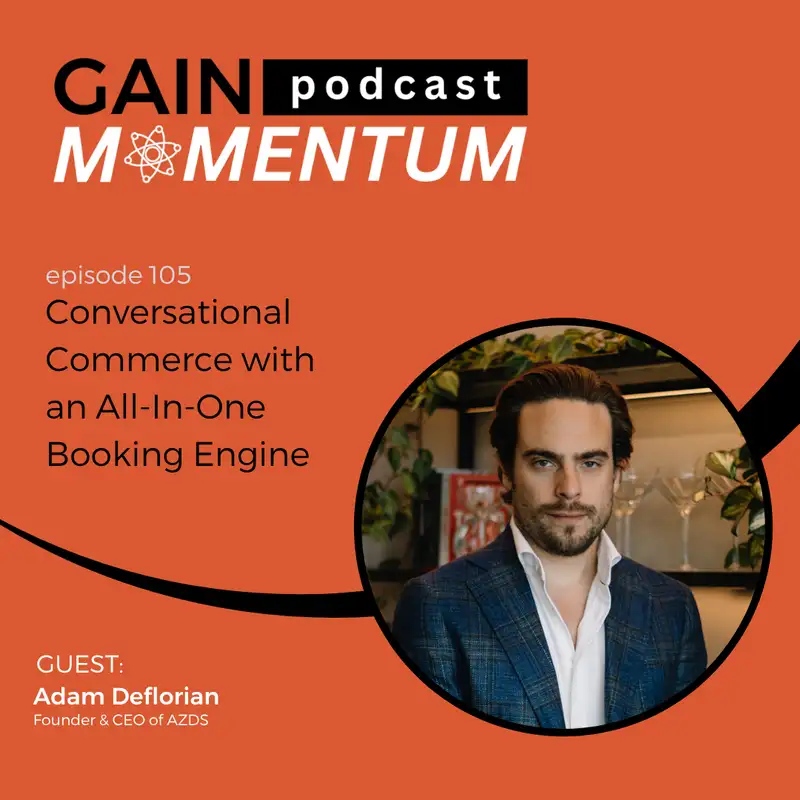
Conversational Commerce with an All-In-One Booking Engine | with Adam Deflorian
GAIN Momentum episode #105: Conversational Commerce with an All-In-One Booking Engine | with Adam Deflorian
===
Adam Mogelonsky: Welcome to another exciting episode of the GAIN Momentum podcast. I'm here with Adam Deflorian founder and CEO of AZDS Interactive Group. Adam, you are the first Adam on this podcast that we've had. made it thus far without, somebody infringing on my own ego.
Yeah.
Adam Deflorian: Such an honor, an honor to be the first Adam with Adam on the podcast. I love it.
Adam Mogelonsky: So, I mean, you know, hopefully our, our last names are distinguished enough between Deflorian and Mogelonsky. I mean, you know, they have some similarities, but, you know, not too many.
Adam Deflorian: Yeah.
Adam Mogelonsky: so AZDS, could you start off with the elevator pitch on the company and everything that you do?
Adam Deflorian: Absolutely. Well, Adam, thanks again for having me. I really appreciate it. Excited to share more about what we're working on here at AZDS and how I got started. So, I founded the company about 20 years ago, really with a focus on luxury hospitality and innovation within luxury hospitality, trying to understand why it felt that the travel and tourism business online, right, was so far behind the rest of online e-commerce and industry, right?
And that's when things were really starting to move, right? eBay was kinda becoming a big thing, obviously with PayPal, Amazon of course, and it was just beginning, right? Things were really starting to pick up in terms of, you know, how people shopped, online. And it felt like there was this, a big area of opportunity with travel because it's so, inspirational, right? It's, it photographs well, that's one for sure. Video, it's immersive. It's something that really is an emotional decision as well, right? There's this emotional aspect when you're booking travel, and it's so vast and of course it's global. And so that's really what I wanted to do, was be able to create websites at the time.
That was our first line of business, that could increase bookings for hospitality for hotels. And with that, we started doing all of the other services at AZDS. So at the time, right, and still, but the core service set is the inspiration, right? So digital marketing services, the owned channels like search engine optimization for Google. And I mean, back then we were focused on Yahoo, of course, as well. And working on figuring out how do we bring more visibility to certain hotels. And we kind of focused on the upper end of the market. And at the time too, right, most of the general managers we were speaking to, they were very adamant that hotels, especially luxury, were not really to be booked online, but rather that they were, you know, phones were ringing off the hook, travel advisors were filling up the hotels.
And I heard a lot of no's, right? A lot of hoteliers that said, you know, "We, you know, thank you, but no thank you. We don't, we don't need it," right? Meanwhile, right, the Expedias of the world, the Booking.com are building up more and more market share, right? And they're generating at a very high cost of sale because of the high commission that they charge, right? They're eating away at the hotel margins. And with that, right, we started picking up a lot more business because the hoteliers had a bit of a, you know, change in approach where they realized, look, if this many people are using the online travel agencies to book and it's beginning to move from a negligible part of their business to 20-plus percent of their business at a 20% cost of sale or at 15, 20, to even 22 at the time percent cost of sale, we better invest in our direct business channels. And that's how AZDS really started growing.
Adam Mogelonsky: Right. And, you know, there's so many different aspects to this to pull apart, but of course, the drum right now for particularly luxury or let's go a little bit broader to experiential properties, is the book direct, and then above that is generating the awareness to drive overall demand, which is another whole issue. The whole idea of, I guess, the separation between capturing that demand via the book channel and then creating your own demand via being an aspirational product. And what I'm gathering from what you're saying is, of course, you have the website which can get everyone once they've landed, but you also have a lot of services and intelligence on what's going to get people to the website in the first place.
Adam Deflorian: That's exactly right. And I think that what we started doing, right, is we really believe, and this is what I think is one of our biggest competitive advantages in the space today. We really believe that digital marketing from when it started back, you know, when we started doing it 20 years ago to the last couple of years, it's become a completely commoditized business, right? Everybody's buying from the same DSPs, whether it's Trade Desk, Google, et cetera, right? Everybody's buying Google Ads. Everybody's buying the same ad space. And what truly differentiates a successful campaign of getting awareness versus not is the audience that you're targeting, right? Who we're actually hitting, right?
And so everybody sells, "Oh, we have a luxury traveler audience," or, "We have a luxury consumer audience." That's what everybody's trying to sell, right? The difference is at AZDS is that what we've built is our own luxury traveler network based on booking data that we create. So, as I had mentioned, started the company focused on websites and digital marketing solutions and really didn't understand why the booking experience was so fractured, right?
So when you go to Amazon or you go to the Nordstrom website, right, there are product pages, and you look at the product, and if you are interested in buying it, you add it to a shopping cart or a basket, and that basket is always present, right? And then you check out. But you don't have product pages, and then once you read about them, you can't do anything with them. You have to go somewhere else to go buy it, right? That just doesn't make sense. It's like-- And that's how the hospitality industry and the travel industry has operated for decades, right? Which is you have these pages of rooms, which are products in essence, or spa treatments or you know, restaurants or activities.
And then we say to the guest, "No, no, no, I'm glad you looked at all of it, but now go over here, enter your dates, and we'll show you what's actually available," right? And, you know, a savvy traveler shops different dates and tries to find the best price and then is looking for when certain activities are available, but we make it really hard to buy.
In 2015, we became certified by Sabre at the time, as well as Trust before that, actually, TCS before Sabre acquired, to build custom booking technology where we could actually integrate the shopping cart right onto the website, and that's what's called RevRaise. And today, it powers over 750 global hotels, and we process over $4.5 billion worth of transactions through it every single year.
We have, we are partners, and we have deep partnership roots with all of the PMS and CRS organizations, whether it now be Abin with Synexus, Oracle on the Opera side, Amadeus, et cetera, because at the end of the day we leverage what they have, right? And it's a win, win, win. It's a win for us. It's a win, more importantly for the hotelier, and it's a win for the CRS and PMS organizations because they make money based on how many bookings they're getting, a per booking fee, and the more bookings they get, the more money they're making.
So it's really everybody is winning in this kind of situation. And then what we do is we actually build audience data based on shopping behavior. We fully GDPR compliant, CCPA compliant based on our data practices, and how we do our data protection. But we anonymize all the data. We have incredible volume of shopping data, behavioral shopping data. And we're able to create audiences, to go back to your question, I like to say it's almost sniper level versus just spraying, right? Because we are giving, we are selling as part of our services when it comes to digital marketing, is people who are actually shopping for luxury hotels, right, on the certain date ranges or the certain regions or the global travel network, and we're able to actually put the right ads in front of the right customers.
And that's what differentiates how we operate from everybody else, is we have that incredibly vast booking data lake that we use to create audiences with. And those audiences are what we say is our secret sauce because we've spent so much time engineering them, creating the right types of audiences to increase the average conversion by about 30%.
So that's really how we operate in a very, I would say, like I said, commoditized space when it comes to digital marketing, but that's how we differentiate ourselves and make ourselves perform a lot better.
Adam Mogelonsky: Right, just to clarify and edify at the same time what you're saying, you’ve developed enough granular and attributable tracking within your technologies, the booking engine and websites, you can form enough intelligence about the buyer personas, either geographic, time of year experiences they’re going after there, you can actually go back to the DSP, the demand side platform, and give very bespoke, upper funnel feeding, to target additional lookalike audiences to generate more demand and have that again be flow-through-able to the direct channel instead of going off to an OTA where so much is lost in the commissions
Adam Deflorian: 100%. That’s-- You nailed it. And I think it’s funny too, right? Because what we’re doing for those to, for our direct customers is what the OTA’s have done for years and is what has made them so successful, right? They are aggregating an immense amount of data around travelers and what they’re shopping for in order to make sure that they’re hitting those travelers at the right time in the right place.
And we’re doing the same thing. We’re just equalizing and making it a fair playing ground, right? Because that’s now something that the direct hotel companies are actually able to leverage as well.
Adam Mogelonsky: Yeah. Yeah. Yeah, and, you got your start and you continue to be a leader in the luxury hospitality space, which right now it’s April 2026, and this category is on fire, so much so that there’s talks now about splitting luxury from ultra-luxury in order to offer some more guidance about making that distinction, whether that’s key count or ADR, everything else that we could do to qualify that split. So you yourself are incredibly close to the information about this space, luxury and ultra-luxury, because of the fact that you’re working with these hotel brands, you’re seeing the nitty-gritty behind the scenes about how things are moving day in, day out, and you’re also figuring out the segments that are going to drive direct demand for the luxury consumer that is less price elastic and also geography elastic in terms of saying, "Well, you know, this place is incredible and it’s halfway across the world, so what? We’re gonna get there. Fuel crisis or not."
Adam Deflorian: Fuel crisis or not, you know, I was shopping just out of straight curiosity, because I’m going to be in Europe in June, and business class tickets out of Denver, where I’m based right now, to Munich, Frankfurt, Paris, Rome, are $15,000 a seat. And it’s... And you look at the seat map. And it’s full. When you pull up to see, people are, to your point, they’re paying it, right?
And it’s so interesting because if you even separated, to your point, luxury and ultra-luxury, ultra-luxury is on fire even more than luxury is on fire. Luxury is on fire too, but ultra-luxury is even more. And our partners are the, you know, Amans of the world, Oetker Collection, Montage International, Rocco Forte Hotels, all the ultra-luxury groups in that space.
And it’s, yeah, I mean, we’re seeing really strong demand, and it almost appears as if from a rate sensitivity perspective, it’s almost they can charge whatever they want. It’s gotten to the point now where it feels like the rate sensitivity is just not there in that segment. People will pay it. And to your point, they’re gonna get there on their $15,000 a seat Polaris seat, and then they’re paying three, €4,000 a night.
I mean, I’ve been-- With our data and insights too, I like to just look at sort of what’s trending, right? And I’m looking across the board at Sardinia this summer and our partners there, and looking at Sicily, and looking at all the top Mediterranean destinations, and I’m seeing very substantial rates. I’m seeing 4,000 plus euros per night before fees, before anything else as the standard in the ultra-luxury. So for a four-night stay, that’s a 16,000 euro stay for a single guest room, and then everything else that comes along with it.
Yeah.
Adam Mogelonsky: Well, it’s the everything else that comes along with it that I’d like to pull a string on because we could talk about the reasons for ultra-luxury being on fire and luxury on fire. That’s a three-hour podcast, a 300-page book, et cetera. But to pull on the string about the everything else, these are the ancillaries.
And really, I always view the ancillaries in the luxury space or the experiential hospitality space as the reason why you visit. You’re not just visiting for a room, you’re visiting for that exceptional restaurant, being taken care of for that incredible pool experience, the spa or wellness center, or access to a yachting experience if we’re talking about Sicily or Amalfi, et cetera. So imagine your surprise when you book a room and then the spa is booked or the golf course doesn’t have the rounds that accommodate you, et cetera. So how does AZDS help resolve that problem of really completing somebody’s stay, either during the booking phase with packaging and add-ons, or even to the pre-arrival point of view in terms of people returning to the website to book more?
Adam Deflorian: Yeah. Great question. And you're 100% right. And it's not even just from a guest experience perspective, which is of course the most important, but it's also from a reservation staffing perspective, right? For people picking up the phone, having to find out is that tee time available, is that experience available that somebody wanted to be able to do before they actually book the room.
So our core product, RevRays, or one of our core product, which is RevRays Book, does offer, you know, ancillary booking. So you can c- go in there and with a room you can add, you know, golf, you can add spa, you can add dining through a variety of different service providers to your stay.
But you do have to anchor it with a room first. And that's about to change for us. So we have a super exciting announcement. Actually, we haven't even announced that it's coming yet. We're going to be announcing that it's coming in May, and we're launching the last week of June. It's a brand-new platform, AI first platform, called RevRays X, which is going to be our next generation booking tool.
And it's not just some additional lipstick or some new GUI or a new UI that we've created on top of RevRays. It's a, you would never know that it's the same product. It's completely built from scratch, purpose-built, designed to solve a couple of different things, right?
The first is what you just mentioned. So this solution allows you to book fully integrated for launch with CRS and PMS partners. Our launch partners are Avansynexis as well as Oracle's OHIP connectivity for Opera as an option. We have integration with Book4Time for spa, integration with SevenRooms for dining, and Lightspeed for golf right into the tee sheet.
Now, what you're able to do with this, right, is a guest could actually just book a spa treatment through the platform. They don't have to book a room, right? Fully integrated Book4Time custom solution. They could book just a dining reservation, or they could start with, to your point, they want to make sure they secure the three tee times for their super important golf trip that they're going on. They want to make sure that the tee times are available on the three days that they plan to visit. They can go in and open RevRays X, add the three tee times to their basket, and then book the room. So then those are held. Then they go, "I want to book a room." You can add the room.
Then you might want to add spa treatments for your wife, or you might want to add dining reservations, and then you can check out and get one beautiful email that has the full itinerary. You can interact with the solution both through natural language because we are built and integrated into an AI orchestration tool that allows you to be able to interact with it both through chat but also with the GUI.
So we're in this kind of intermediary phase of AI, right? Where not everybody wants to use ChatGPT or Claude or their preferred LLM by just typing, right? Which is the normal utilization. You just type in, "I want to book a room," or, "What's the best room for a family of four?" Or you know—and with RevRays X, you can do that. So you can interact with it the same way as you interact with your ChatGPT assistant or your Claude assistant.
But you can also click. So when you open up the new solution, we have buttons, right? Book a room, book golf, book a table, book a spa treatment. And when you click on that, you can fully interact with it with your mouse too. So instead of just typing, you can actually interact with it in a GUI form or a true UI form. But on the back end, all it's doing is prompting. So even if you're clicking, it's AI first. We are actually telling the assistant to go check availability for these dates.
And it's funny because if you scroll up in the solution, and I'll have to give you a sneak peek another time of it. When you are scrolling up, you can actually see the commands because it's just a chat screen, right? So as you're scrolling up, it's giving it commands. So even if you're clicking and you're like, "I'm not using AI, I'm not typing anything, I'm not typing sentences," the solution actually is just prompting it on what to do.
We found this space too because our belief is that ChatGPT today, or Claude, or your preferred AI assistant is pretty good at planning itineraries, but not booking them, right? And the same with Mindtrip and many other great solutions out there. They're all awesome, but they're more research-based tools. They can’t really—they don’t have inventory directly integrated into the platform. That's going to be the biggest thing when it comes to travel, right, is inventory. And direct inventory into not just the rooms, of course, but like I said, spa, activity systems, golf, all of those things.
And so the space that we see we're filling temporarily, right, is people are still going to come to the website to really get the full understanding of the property, what it has to offer, look at pictures, look at videos. But then they're starting to get into a more natural AI utilization, and that's where you're going to have savvier customers that are going to start using and interacting with RevRays X similar to the example I gave where somebody might type in, "What's the best room for a family of four? What activities should I book for my eight-year-old and six-year-old? What are your signature massage treatments or your more local, locally curated spa treatments?" You might ask, "What's the best time of day for a two-hour sailing expedition?"
So those guests, and then the more we learn about that guest, to your point earlier, we can actually personalize the entire buying experience based on what we know about that guest. So if the customer just told the AI assistant that they have a six-year-old and an eight-year-old, then the suggestions and how the overall vacation package gets presented should be very different than if I asked, "I'm a couple coming for my 30th wedding anniversary." It should look very different in terms of what I'm actually doing. And the more information that the customer or the guest is volunteering, the more personalized, the better I can actually package and sell, and my conversion rate on those ancillaries is going to be a lot higher because it's like instead of selling...
You know, the example I share with hoteliers all the time is, if you are walking down the street, right? And it begins to rain, right? Then it seems very reasonable and high likelihood that if you sell me an umbrella, I'll pay $30, $50 for an umbrella. It's a useful thing if I'm walking to a meeting and it starts dumping rain.
Alternatively, if you are walking down the street and it starts dumping rain, and somebody's like, "Would you like this MacBook Pro?" Your conversion rate is probably going to be pretty low, because why would I, at that moment in time, want to buy a MacBook Pro, right? And that's the way that I think we've been missing the mark in hospitality for so long, is we present these gigantic lists of things that people can experience, and we're like, "Here's this big menu," much larger than a restaurant menu. Here's all of these different things. And what's actually relevant for me is a small subset of that, and what's relevant for you is a small subset of that. And that goes back, people are calling that AI. That's not AI, that's personalization. We just haven't been able to do it effectively or well in hospitality ever.
I mean, everybody will tell you that with the correct CRM and/or good CDP tools, but we don't. We just struggle with personalization, right? And so that's the approach.
Adam Mogelonsky: I mean, we've done the personalization not at scale, particularly at the luxury end, simply by throwing more bodies at it. Team members, hosts, associates, people to, when people come up and say, "Well, what spa treatment would you recommend?" And then people that have studied the six-page spa menu to actually know and to recommend something. But this is finally at scale, where there still are so many luxury places where the spa menu, when you drill down, it's just a PDF that's uploaded onto the website instead of it being something that's in XML or something else that then could be interpreted by some sort of mapping schema to make it accessible by AI to thereby deliver that personalization.
And what I'm getting at, you mentioned earlier the technologies, the piping behind the glue from various inventory systems. Seven Rooms for dining room, golf, POS, and then for spa you're using Book4Time. And essentially all those have their own GUIs for booking, but the problem has always been getting a person into an individual flow, a full continuous flow to really make it that Amazon or Nordstrom experience where it can be that add to cart and it doesn't matter whether you're buying a spa experience or golf or any other time-based inventory, but it just is there and it makes for a more pleasurable experience. And then adding that additional layer of prompting to curate these long menus of everything that is available into that personal experience. I mean, that's been the Holy Grail for 20 years, just we've solved it by throwing bodies at it.
Adam Deflorian: Yeah. Yeah, exactly. And I can tell you it's funny because we, like even at the, some of the best, I'm not going to name any partners that do this, right? But because I stay at many of my great partners all the time, and I can't tell you how many times I show up to the front desk, right? And that front desk agent, in theory, would have the CRM screen up, right?
Because that's what they're supposed—That's why they're supposed to have that tool, right? To know whether I've stayed there before. And I've stayed there nine times, and they're like, "Oh, is this your first visit?"
Adam Mogelonsky: Oh.
Adam Deflorian: and, but it, You but and you get that every... And you're just, you just feel bad. You're like, it happens more often than not. And it's because of the discrete systems. It's because of the lack of connectivity there. And another thing, like on that point, on the digital buying experience is RevRays X is also the first of its kind where if I book a room, let's say, right?
So I come to the, and we've, by the way, we've created these flows. They're frictionless. So the one thing that I'll say, right, is you throw too much at somebody, and then they don't buy anything, right? So the last thing I want to do is lose a room booking for a customer or for a hotel because it was too complicated and I was throwing them spa and dining and other things at it, right? That's the last thing I want to do.
So if you just come to book a room, it's as easy as possible. We've spent so much time, our chief experience officer, Hills, does an incredible job from a UI perspective, his team of just dialing it, making it so simple, testing and ensuring that it's the ideal flow.
And what's interesting about that, right, is that if you book a room and then you leave the website, when you come back to the website and you reopen the booking engine, it's going to know you had the room, unless you're using an incognito browser or you're not an assigned stay, right? There are versions where that won't work, but for the most part, most people's it will, right?
You come back, and we aren't going to try to sell you another room. You have a room. We know that, right? We're going to try to sell you spa and dining. Would you like to add a reservation for dining to your itinerary? Would you like to add a spa treatment to your itinerary, et cetera? So we've really, I think, perfected, so to speak, as best as we possibly can, that flow where you come back to the website and we're not starting from square one. You're actually adding on to your existing stay.
Adam Mogelonsky: uh, somebody comes back to your website and they may have looked at dining or they may have looked at spa. is it at a point right now where you can recognize that somebody has already bought a room and now they're ready to buy ancillaries, but can you go down to the next level of already curating the ancillary experience to say, "Listen, we've identified that you're most likely in the foodie segment, and therefore we're going to hit you with some restaurant curated ancillary offers," versus somebody who's a wellness guru or something like that. Can you drill down that far?
Adam Deflorian: Yeah. Yeah. We're—we can drill down that far, and we can even drill down similar to what you just mentioned on the sales side. We curate questions within the AI assistant so that if, for example, you have told it that you have a six and an eight-year-old, what's the best room for a family of four?
It shows the suites, let's say the one- and two-bedroom suites, right? Then it gives three pre-created questions, and those questions in that example would be something like, "Can I add a rollaway bed to the one-bedroom suite?" "Do you have pull-out sofas?"
And so then if you're shopping, let's say you've—so it actually prompts intelligently the right questions that somebody might be asking. They can ask whatever they want. They can type in whatever they want. But we're giving them further prompted questions that they might be next to ask, kind of like a reservations agent would be trained to do.
And then let's say you get to dining sections, and the prompted questions might be, "Does your restaurant have high chairs?" "Is there outdoor and indoor dining options?" Right? So the questions are always relevant to what the person is searching for.
And it's pretty darn good. The models that we are integrated with are so good that I'm actually blown away on it. I go and I'm playing with the dev links right now, and when I start asking it questions, the type of question prompts that it gives are so good. I'm like, these are questions that I might not even think to ask till I arrive in the lobby and my wife is yelling at me, "Why didn't you ask this?" Right? These are the types of the—it’s predicting the right questions. It's so cool.
So
Adam Mogelonsky: and within that, in terms of prediction, you did mention GDPR and California compliance, and that is an important topic that I know IT directors are always asking about is, you know, somebody comes in, they ask a question, then they leave. They haven't necessarily bought anything or opted in, yet just because they left and didn't buy anything doesn't mean they're not still a customer. They're still potentially buying. They just need to wait a little bit, particularly if it's a 4,000 euro a night stay. Even though it's ultra-luxury, they still need time to think about it.
But how do you manage those levels of compliance when dealing with the data that is not directly attributable to an express opt-in?
Adam Deflorian: It's hard. So the first step of that, right, is integration with the cookie management tools and consent tools like OneTrust. So we have full integrations with the OneTrusts of the world that basically control from a compliance perspective and ensure that the behavior and the tracking is personalized based on the preferences that that customer has chosen.
And then from an overall data compliance perspective, it's ensuring that we're using different availability and regions of both Azure and Amazon Web Services to make sure that European data is staying on European Union servers, right? And from a global perspective, we have a really phenomenal third-party partner.
His name is Rich. He's a partner at a law firm that we work with out of Charlotte, Hol Booth & Smith, and they do an amazing job guiding us and reviewing all of our DPAs, our data privacy agreements, how we operate in terms of auditing and making sure that we are hitting all of those boxes from a compliance perspective.
So compliance is one thing, and we rely a lot on Rich's team for that. We also have an in-house security team led by a former CIA station chief in cyber for over 20 years. So from a cybersecurity perspective, which is very adjacent to that, everything we do has to be as secure and buttoned up as possible too.
So we really do invest in our internal resources and external resources too, partners to collaborate with, to make sure that we're doing everything we need to be doing.
Adam Mogelonsky: Yeah. I mean, you're creating a more frictionless experience for the user of the hotel,
so that way they don't need to worry about where the data is at rest and how it's encrypted or on European servers and all the actual legal side of that. They can just focus on hoteling and
ensuring that people that are paying €4,000 a night are getting the best possible guest service that is expected for that price.
Adam Deflorian: That's exactly right. And that's the other funny thing that comes up in the industry a lot. I'm sure you hear it too, right? Especially with the larger organizations, they're like, "Should we build or should we buy?" You know, and a lot of the times, to your point, a lot of these organizations are like, "All right, let's try to build it," and then they realize, "We're a hotel company.
Let's stop this," you know, "and let's actually work with a technology company to build technology for a hotel." I mean, over the years, I've had many examples of partners that have tried to build things themselves that have sort of eggs on their face, so to speak, that then end up coming to AZDS to have us build solutions for them, because at the end of the day, I don't know how to run a hotel.
You know, from an operations perspective, it would be a very poorly run hotel if I did that. But I do know how to sell and build technology that improves the online experience for hospitality. And so I think it makes a lot of sense to leverage true professionals like us that have expertise in that space.
And then think about from a data perspective. So we've been talking about data privacy, but think about with the volume that we are transacting with, we're actually using that data to better our user experience. So we're constantly analyzing user behavior and video recordings using AI to analyze video recordings of users on the booking engine and where they're getting stuck, where they're dropping off, how they're interacting with it, so that we can better our products and better our new solutions like RevRaysX.
So it's analyzing all of that to be able to use it, and we actually have a platform from our data and business intelligence team called RevRays Insights. It comes with every RevRays booking engine. So part of the platform is access to Insights, and Insights is our benchmarking tool.
So it is, we have a proprietary, pretty impressive data lake that we've built in Snowflake that's connected into GA4 and all the meta platforms and Google and everything else, so that we can create beautiful dashboards for our hoteliers to be able to see their own performance of not just the booking engine, but the website as a whole.
And then they can actually benchmark against I mentioned, you know, it's huge volume. It's four and a half billion dollars a year worth of actual transactions. They can benchmark against the total global luxury set, but they can also benchmark metrics like look-to-book or organic growth or traffic growth or booking window, right?
Lead time or most commonly shopped dates. All the different things that hoteliers have access to that data, but they don't really know what does good look like. Like how do you define good? So we allow them to be able to do that with Insights and make strategic revenue management and distribution-related decisions on data that doesn't just come from ideas and other great platforms out there, but actually what's happening on their website compared to other websites for similar luxury hotels.
And it's very unique because it's cleansed, right? So from a data privacy perspective, it's not like they would... You can't be like, "Oh, I want to compare against these six hotels," right? Le Bristol in Paris and, you know, and Aman, Yara, et cetera. Like you can't do that.
But we have sets, right? Like we have US mountain, we have European mountain, we have US beach, we have... And you can compare against those and look at it. And we have it, the index, which is what those are, and you can compare how you look like against index. We also have our-- We've created this really impressive forward-looking modeling.
So the forward-looking modeling is we call them summary graphs, right? Where you can actually look forward. So at this point in time, how do you compare to the last four years in terms of bookings for May, June, July, August? So like, are we behind or where we were in one of those years?
It's forward-looking modeling instead of just always looking at historic consumption.
Adam Mogelonsky: Yeah. So yeah, I mean, forward-looking pacing intelligence is huge, right? And you know, it's a tool that every revenue director wants, or is frustratingly stitching together with Excel files in various ways, right? And putting it all into an intelligence dashboard can just allow for more intelligent decision-making.
And also, where we're heading with all this is personalized pricing according to who you deem your best fit guests are.
And so we've covered RevRays Intelli- RevRays Insights, RevRays X, the soon to launch all-in-one GUI or booking flow. And where is this going? Where is BookDirect going to create this holistic AI-driven personalized experience digitally to help drive more heads and beds and more ADR and RevPAR and all those beautiful things.
Adam Mogelonsky: Yeah. no, it's a great question. I actually, to be honest with you, I thought last year at HITEC, so, you know, last June, I thought that we would be further ahead in terms of booking directly through the AI, the LLMs. Like, I thought that booking would be further, completed in terms of integration.
I always knew MCP wasn't the solution, but I thought that we would be further in terms of being able to actually book through Claude and ChatGPT, and we're very far away.
We're just as far as we were last June, because yes, there's the Expedia and Booking.com partnerships, but they're really just almost like ads, right?
And then you click on it, it links you out to Expedia or Booking.com.
So I think that this hybrid flow that we've built with RevRax, this model, right, I think is gonna be here for a little while. it's adding and creating larger overall shopping basket size, right, within hospitality.
And then I think ultimately it will become a world where there are, the majority of guests are gonna be booking through the AI assistant of their choice, whether that be ChatGPT or Claude or Gemini. We have time, but I do think it's getting there where those itineraries will be fully bookable.
They're going to have to figure out connectivity. It's gonna take time. It's super complicated. And I actually would argue from, yeah, even outside of the industry, one thing that I think we do a really good job of at AZDS is that we a lot of hospitality-focused digital agencies.
Not to say anything negative about competitors. We have a lot of great competitors that are really strong against us and have great services. But a lot of the times, right, they're looking at travel and tourism for their inspiration. like, number one rule at AZDS is don't look at travel and tourism as your benchmarks for a new website build, for example, right?
Look at who does it really well. So in luxury, for us, that's brands like Miu Miu and Balmain and Loewe and Louis Vuitton, and we look at all of these luxury retailers, right? Because they are so much further ahead in terms of overall UI and how they build and how they shopping cart and all of that.
We look at automotive, we look at Tesla, we look at Lucid, we look at all these different brands that we think are doing a really good job. And then we come back to travel, right? Because travel, if you just look at travel first, you're gonna look like every other travel website, which we don't wanna do, or travel solution.
So that's why we spend the time to really look outside the industry. And my point being that what ChatGPT is doing right now and what Claude is doing right now is they have to actually really figure out their entire commerce model, right? Because actually, from a, even a retail perspective, ChatGPT right now is not very good, right?
Like, when you go onto any of these AI engines to buy clothing or buy a product or whatever, they haven't figured that out yet. That's next, right? So once they start figuring out the entire commerce model, I truly believe that they will fit travel into that commerce model, and that's the right way to think about it.
It brings us back full circle to the beginning of our podcast, where I was talking to you about why hospitality has this bizarre obsession with website, and then you go shop somewhere else. If from the very beginning, right, they're architecting with these AI companies the ability to actually have a commerce model and travel fits into that commerce model, that's exactly what they should be doing.
And so I think that's where the future is then gonna be headed, is that the commerce models are gonna get better and built around these ChatGPTs, Gemini, Claudes, et cetera. And then travel's going to fit inside of that, and that's then a direction we're headed.
Adam Mogelonsky: You know, I've always seen the LLM travel search as having a very similar problem to the OTA's or a challenge as the OTA's, which is everything looks the same. The UI. There's no emotion that sits above it, and emotion is really generated through video and images. And, you know, there still is something to be said about a beautiful website, with a great underlying UI flow, underneath that in terms of really getting people to feel the brand,
to then-- And then also feel the value for that ADR, to then get them towards the finish line of converting into a booking with lots of ancillary to attach to it.
Adam Deflorian: Especially with luxury, right? I mean, that's how you differentiate a 4,000 euro a night hotel from another 4,000 euro a night hotel.
Adam Mogelonsky: Yeah, but expanding that out into travel is how do you get someone to go to Costa Rica versus Panama?
Adam Deflorian: Totally. Yeah. And then I think the other way that I frame that up when I'm talking to DMOs and CVBs and other folks that we work with too, right, is that people want to book a trip, and a trip includes getting there, the flight, includes a rental car, includes the hotel, includes the activities, includes dining, the spa, all of these things.
These are just components of a trip at a destination level, right. We over years have told people that to book a trip, you first gotta go to united.com or delta.com, right, and check if there's flights. Then you gotta go check if the hotel's available, right, that you want to stay at or do some research to figure it out.
Then you go do the rental car, right. And then you go back to the hotel website and book the fractured spa, or you pick up the phone or you email them.
So that’s what we're trying to like—this can be done both at a hotel level, as I was talking about with Reveray's X, but if we go up one above that, I think that my ultimate goal, and when I think that we'll have established the holy grail, so to speak, is when we can actually do this for a destination.
We're in discussions with all sorts of countries, DMOs, states, all different markets to figure out how we can achieve this and how we might be able to make a solution that is one above what I just talked about with Reveray's X. So that's super exciting for us.
Adam Mogelonsky: Yeah. Yeah, I mean, there's so much that goes into trip planning and trip booking. Flight, the logistics, and then the other word you didn't mention is insurance,
Adam Deflorian: and insurance.
Adam Mogelonsky: very important for especially the luxury traveler, but also a boomer-led economy. A big trend that's coming up is going to be what happens when the average boomer is 80 years old and insurance premiums for traveling, medical or otherwise just go through the roof.
So the trend that's related to that, you could say, is the growth of luxury cruises and all these yachting experiences. That's their market because it removes that friction.
Adam Deflorian: 100%. And it's everything. It takes care of everything for you, right? You just book the cruise and it has everything as part of it, and you know where you're staying, and you're getting to amazing destinations without having to go through really busy airports and all of that, right? And the food is exceptional. And if we go back to what you said, right? Everybody wants the bigger basket. They all want a larger average order value. Well, you get that with cruise versus hotel. That's why you see Orient Express there. That's why you see Aman there, Four Seasons Yachts, Ritz-Carlton. Everybody's getting into this space because it's the best possible customer, right? It's somebody that's spending instead of two or three nights with you, they're spending four to seven or longer. Everything is included, so the average price point is so much higher, so...
Adam Mogelonsky: Yeah, but even then one step higher, destination-led conversational commerce then ties into the pre and post for where people are embarking and disembarking for those ports of call.
Adam Deflorian: exactly
Adam Mogelonsky: Yeah, so there's huge opportunities just layering things in, all built around that single GUI and adding additional pieces in to go from a hotel booking to a total revenue booking and now to a trip booking as a platform.
So one other element to this, is for a hotel website, is something I call the digital storefront, which is the merger of front-end website and back-end. So we talked about how you're able to remember information compliantly where somebody enters, they book a room, they maybe look at some ancillaries, but then they don't. Then they come back into the booking engine and it's giving them more personalized offers around what they previously viewed. So it's creating that lensing, it's removing decision fatigue, all that stuff. The next step also would be how can you merge the front-end website, whichever CMS it's built on, and the booking engine, so that way from the moment they book that room then log off, then they come back two weeks later and they're ready to book those ancillaries, whatever they looked at before, now they're getting a, for example, golf-led website experience versus a still a hotel website experience that's trying to sell them rooms. It's already engineered to get them across the finish line for what we know about that guest.
Adam Deflorian: Absolutely. And that's—We're working—we do have partners with the right CRM and CDP connectivity to be able to do that, right? So that we can personalize the entire website experience and not just the RevRaise overlay that comes out, right? So basically, you know, if we, like you mentioned, it could be family travel or it could be couples and it's showing and leading all the content with it.
The gaps we see today, right, are there are partners of ours that do it really well, then there are partners that just don't have the content to get it done. So that's the other core piece, right? AI is making that a lot easier though, right? Generative AI, you can begin to do, without necessarily that whole new photo shoot, you can actually be able to create and modify pictures, as well as content on the page, video, things like that.
Adam Mogelonsky: Wow. Yeah, it's getting there. It's just a matter of how much development money you have to throw at it, right?
Adam Deflorian: That's right.
Adam Mogelonsky: So, Adam, we've covered a ton of ground, and this is a very exciting time for creating that experience through the direct website and really driving total revenue, not just for luxury and ultra-luxury, but really any experiential property at any level: boutique, eco lodge, whatever niche you want to operate in. There is a way to personalize and deliver something incredible and really meet those technologies that are coming out head-on. What other trends are you seeing, technology-related or just travel in general? And how is AZDS pivoting to meet them?
Adam Deflorian: Yeah. So I'd say the biggest one you hear about, it's almost taboo, but it is what everybody is talking about, is experiential travel. So wellness-related trips, once-in-a-lifetime experiences. We're working a lot around that with things that relate to full booking, destination-level booking, and that allows you to integrate into the overall funnel.
The other thing we're seeing a ton of is very off-the-beaten-path. So in addition to experiential and once-in-a-lifetime and wellness-focused trips, it's lodge experiences, where everything is included. So it's all-inclusive travel, but done at a really high level. And I think it's interesting because what's having a moment right now from a trend perspective, from what we're seeing, one of our newer partners is Beckons, which brought together Bailey Lodges and Tierra Hotels under one umbrella with KSL Capital Partners, and the team there is doing an incredible job. We're working with them on building the new experience for that.
But it's those seven to 25 room unbelievable lodges in incredible places in New Zealand, Australia, and Patagonia that have just—and it's all included. Everything is included. We're seeing that take off. You see it with our partners Nayara Hospitality in Costa Rica and other destinations that are really incredible but also sustainable places for people to go to.
So that's what we're seeing really light up right now.
Adam Mogelonsky: Yeah. That is the future of travel. I've always said that it's hard to deliver personalization when you get above 100 to 150 rooms, because your headcount is so high that the guest is not having that second, third, fourth encounter with the same person, which is the lifeblood.
A lot of these exclusive experiences are just too hard to get tour operators around to really do that in remote locations like Patagonia or Uluru in the exact middle of Australia, where I believe Bailey Lodge has a location.
So that really means it's so well curated from that five to, let's say, 50 range of ultra-luxury, whether lodge or resort. There's so much growth there, and it requires teams to be nimble and have great technology to underpin that. Imagine you show up in Patagonia and you've been looking forward to that $10,000 horseback riding trip through a glacial mountain range, and they've already sold out for that day because there are only six horses and you didn't book in time.
Or you can't get a helicopter to be flown up for a whiskey tasting on top of a glacier where they're chipping the ice straight out.
Adam Deflorian: That's exactly right. That's actually an amazing experience. The Glacier Whiskey—I did it in Alaska at an incredible lodge called Alaska Sportsman's Lodge, which does this. Brian Kraft, the owner of that lodge, does an unbelievable job of creating that personalized experience.
Every night you come back into the lodge at dinner and everybody from the day is talking about the fish they've caught and what they did during the day, the glacier flight, all these things. The guides come out and they're talking about what we're going to do tomorrow. That kind of personalized experience is dialed in.
Another thing we're seeing too is sports, especially tennis, golf, and Formula One. It's having a major resurgence. Sports tourism is getting people to particular places around big sporting events, and then extending their stay dates before and after.
That's why you're seeing, especially in the Middle East with Saudi Arabia, such a big focus on bringing everything into the kingdom, because it attracts people to stay longer and spend more.
Adam Mogelonsky: Their strategy is incredibly smart. Related to sports tourism around specific events, there's also athleisure escapes. You mentioned Amanara in the Dominican Republic, and I believe that's the one where Djokovic now has his tennis residency.
So imagine going to that resort specifically to have face time with Djokovic, but he's already booked the entire time you get there because you didn't book early enough.
Adam Deflorian: That's exactly right. That's the theme of our whole conversation today. It keeps coming up.
Adam Mogelonsky: Yeah. I love what you're doing. It's incredible. I hope this conversation has inspired hoteliers to really think about the depth that their partners can bring to all that intelligence and all those additional automations that can be brought in to drive total revenue, which drives guest satisfaction, more bookings, and a stronger business cycle, and at the end of the day, delivers great experiences.
Adam Deflorian: Absolutely.
Adam Mogelonsky: Adam, thank you so much for coming on the show. It's been fantastic.
Adam Deflorian: Of course. It's been a great chat. I'm honored to be the first Adam. Hopefully we don't have another Adam coming up next week so I can hold the title for a little while.
Adam Mogelonsky: You will. I’ll make sure of that.
Adam Deflorian: Thank you, Adam. Appreciate the time.
Adam Mogelonsky: Thanks.