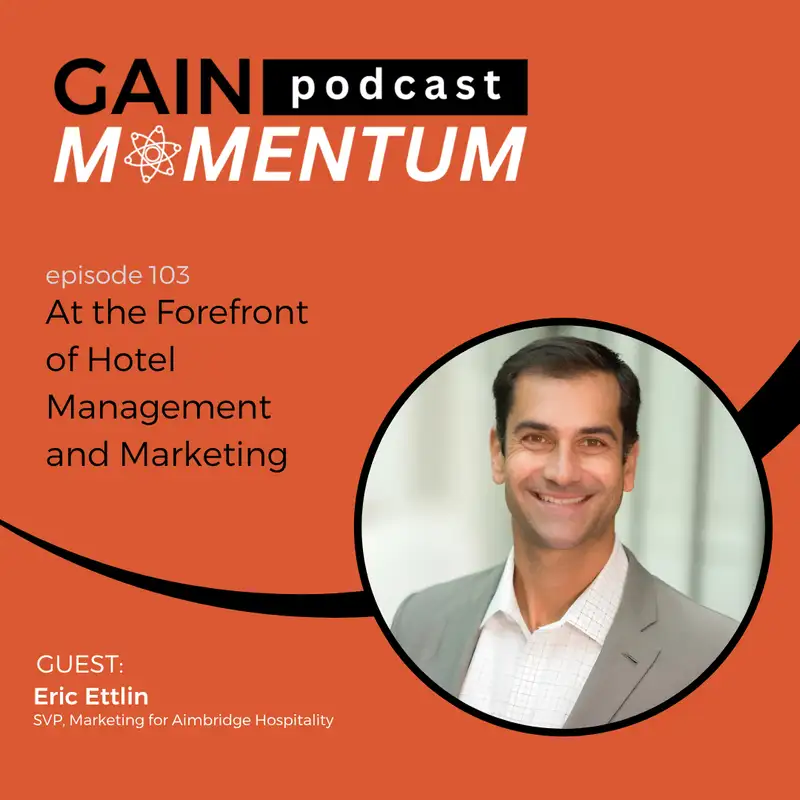
At the Forefront of Hotel Management and Marketing | with Eric Ettlin
GAIN Momentum episode #103: At the Forefront of Hotel Management and Marketing | with Eric Ettlin
===
Adam Mogelonsky: Welcome to the GAIN Momentum podcast, focusing on timeless lessons from senior leaders in hospitality, food service, travel, and technology. I'm joined today by Eric Ettlin, Senior Vice President of Marketing at Aimbridge Hospitality. Eric, how's it going?
Eric Ettlin: It's going well, Adam. How are you?
Adam Mogelonsky: I'm doing great. I mean, it's first sunny Friday here in Toronto. We're recording end of February and I guess the groundhogs in Poughkeepsie were wrong about it being only six weeks from winter. So I think it's coming a little bit better. Eric, to start off with, everyone in hospitality knows about Aimbridge Hospitality. You guys are that important.
Give us a sense of scale in terms of Aimbridge Hospitality, how many hotels you have under management, and all other services that you provide.
Eric Ettlin: Yeah. So Aimbridge, as you know, is the world's largest third-party operator with approximately 1,000 properties in our portfolio.
Our largest operating markets reside within North America, but we also have a European division, Middle East and Africa, Latin American division, and we're currently exploring more international markets.
So yeah, last year we launched a dedicated division focused on all-inclusive properties both in the Caribbean and Latin America, and it's probably our fastest growing segment. So, as we continue to evolve as a company, size is less relevant. Owners are really focused on the results, and that's where we tend to really stand out in the industry.
Adam Mogelonsky: Just to color that some more, you mentioned all-inclusive. That is a very tough thing to manage for hotels, and the toughness of it is probably an obstacle towards going towards an all-inclusive from an a la carte or a European plan model. Could you color how you guide hotels to make that a reality?
Eric Ettlin: Yeah. So we're making a major investment into that space. We know that we can't just bolt on existing hotel operations, even operations for big resorts that we currently manage.
It's just a different model, and it's a whole different approach. So we are bringing in the best in the industry to help us guide through the all-inclusive growth and expansion, and we believe that we have set up the best team in the industry to help us do that as a third-party operator.
So
Adam Mogelonsky: Awesome. And because this is a hotel podcast, a hotel technology podcast, I am wondering, and I'm sure our listeners are wondering and they're often maybe confused by this, what role do management companies take in technology decisions and technology administration? And then within that, are you personally actively involved in tasks like vendor selection, system configuration, customization, and so on?
Eric Ettlin: Yeah. So with Aimbridge's scale, it really is a differentiator for us in that space, right? So we're constantly evaluating all different technology platforms that can be rolled out in mass and at better price points for our owners, for our hotels, and ultimately that our guests get to experience, right?
So as you think about platforms that I'm involved in selecting and managing across the scale of Aimbridge, you're looking at social and reputation platforms, especially in the new world of large language models.
It was once the case where a customer or a guest would go to TripAdvisor or they would go to Google Reviews.
Well, now large language models can compile all of that feedback, all of those reviews in real time and give a guest a kind of review score index of sorts, right? So reputation management is absolutely key. We have a vendor partner that we've selected that we work with that will give the real-time alerts to GMs, centralized response workflows, sentiment reporting, scorecards for performance measurements, and tie all that to the actual performance of the hotels because we know it has such a big impact.
So that's one technology platform of many others. We have independent hotels at Aimbridge. We have soft brand hotels at Aimbridge, such as Autograph by Marriott, and these properties have their own independent websites. So my team manages the independent websites outside of the brand platforms.
So when selecting a content management system for a web platform, it's absolutely critical that we have the best in the business. So our teams will select the content management systems, marketing operations workflows. If you think about my team of 65 marketers within Second Wave and Aimbridge, they're managing marketing efforts on behalf of 800, 900 hotels.
And so to be able to manage just the marketing operations, which is not the sexy part of the business, but it's absolutely critical for completing the work and making sure that the tasks are being divvied out to the appropriate people involved. Other areas that we focus on from a technology platform standpoint are our email marketing platforms, the creative platforms. Some of the creative efforts our team within Second Wave will do above property, but then we also want to select creative platforms that enable our directors of sales on property to be able to create a flyer for an event or update a menu and things of that nature. So there's a whole host of different technology platforms that we're constantly evaluating and assessing for the benefit of our hotels so that they know and they have the confidence that when they join Aimbridge, they really are getting the best from a tech stack perspective.
And when you look at the new world of AI, right? I'm sure you don't get through a podcast these days without diving into AI in some way, shape, or form. And so we're assessing... Actually we had five meetings this week alone where we're assessing large language model traffic tracking, customer sentiment, platforms that help us understand how are people searching for hotels in certain markets and ways that we can geo-optimize. That's the new SEO, geo-optimize our websites so that they are being picked up by the large language models and we really are the top of the list for large language models and agents to refer our hotels over competitors. So it's a constant ever-evolving process of technology vetting and really understanding what is the best tech out there and how do we bring that to our hotels.
Adam Mogelonsky: You sort of stole a lot of questions I was gonna follow up on right out of my mouth there. But it is important to cover off everything that marketing does because on any given day you're juggling 20 different tasks and 20 different platforms, and really looking at that systemically from the entire guest journey, from mentioning reviews to updating websites, and now this whole idea of generative engine optimization, GEO, or machine readability.
The exact term is still being defined.
Therein you mentioned a term, Second Wave. What exactly is Second Wave, just for clarity?
Eric Ettlin: Yeah. So we often get asked this question. Second Wave was born out of a luxury lifestyle division of Aimbridge called Evolution. And Evolution really wanted to be the differentiator for luxury lifestyle hotels. This started about 10, 10 plus years ago. And so they said to themselves, this predates me, but they said, "We wanna build this new marketing arm specifically focused on hospitality for our hotels to support our properties and our owners, and it's going to be the next wave of hotel marketing."
So they named it Second Wave. And so that has now been adopted as the name for Aimbridge's in-house marketing team. So I lead the Second Wave team here at Aimbridge. And now instead of Second Wave just covering the luxury lifestyle hotels within Aimbridge, we've now scaled that out to cover all properties within Aimbridge, select service all the way up to big box resorts and all-inclusives.
Adam Mogelonsky: Right. And one of the advantages that I see, and I'm sure your hotels under your management also realize this, is when you have the marketing entity that also works hand in hand with other parts of the commercial team, revenue management, sales, you can realize a lot of synergies. So I'm wondering, could you discuss how Second Wave or other marketing team members at Aimbridge interact with the overall commercial strategy?
Eric Ettlin: Yeah, absolutely. This really has been a major focus of ours over the past several years. Under our chief commercial officer, Allison Handy, she has really put together one of the best in the industry commercial support arms for our properties. And this trickles throughout the organization, but her vision of bringing together sales, marketing, revenue management, and now she has a new head of distribution as well.
Those critical groups working in synergy together is really what makes us the best in the industry, and we are in lockstep on a daily basis, constantly communicating on which markets are struggling, which hotels within those markets, brands, hotel types, and then how do we come together as a commercial arm to leverage the power that we have working together?
If you think about everything from the pricing strategy that the revenue managers put in place, them communicating that out to marketing and sales, and then sales communicating with marketing when groups fall out or we have group wash, we can come in and support the properties to backfill the transient and driving that short-term demand.
It really, when it works well together, it's a very, very powerful thing. And at Aimbridge, we feel that we've really cracked the code on that, and that we see the results every single day.
Eric Ettlin: We are. We started an AI task force within Second Wave about a year and a half ago, and we knew the AI revolution was coming, and we wanted to hire folks that were specialists in AI, but we knew that that was not gonna happen overnight. So we also understood that there were many people within Second Wave that had interest and experience in artificial intelligence, so we put together a task force, an internal task force, and we carefully selected individuals from all facets of marketing within Second Wave to represent their respective areas.
So if you think about marketing account managers that we have that are the direct connectivity point to our hotels and our owners, they needed representation. Reporting analytics, obviously without the data, AI is not useless, but it's much less powerful. So we have a data scientist on the AI task force.
We have a member from our branding team. So Second Wave actually has an in-house branding team to represent, and we have our paid media representative. So we brought together this collection of internal folks that were curious. At Second Wave, we always wanna stay curious so that we can stay on the cutting edge of technology, of strategy.
And the task force initially was more education and exploring what is out there. What should we be focusing on? What AI platforms should we investigate to help move our business forward? And so we started small, but then we started running pilots to leverage AI for things like ad copywriting.
We started leveraging artificial intelligence for our branding team to help them with image generation and speeding up the branding process and loading our brand-building strategies into AI platforms that would help us build out brands more quickly, things of that nature. So that was kind of the beginning of our exploration in AI, and now we're moving into the world of building in-house AI platforms that help empower our business.
So we've just at the end of last year rolled out an artificial intelligence machine learning budget planning tool. So historically, in all of my career in marketing, paid media budgets are built during the budgeting process for hotels, and those paid media budgets have been very manual. They're built out, they're presented to owners, and then they're implemented, but rarely are they brought back every single month or every quarter and reevaluated based on the changing dynamics of the property, right?
How has the demand shifted? How has the market changed since we originally built those budgets? Well, now with machine learning and AI, we had our data scientists compile all the different historical paid media campaigns that we had run for every single one of our hotels, compiled those, looked at performance and trends and seasonality, and it spits out a recommendation on what should we build the budget to be.
Now we're incorporating forward-looking forecasts into that. So now in real time, we can adjust our paid media based on that forward-looking forecast. So we're really stitching together all the historical data, future-looking forecasts, and it's making us more nimble as marketers to get smarter about the way that we spend our hotel's money to drive transient business.
Adam Mogelonsky: Wow. I mean, it's huge and I hope it's clear to everyone the enormity of what you're talking about in terms of all the tasks, the potential that AI can offer, as well as how that integrates with your work to lead the marketing division. And the sum of all this is that you recently won an award for all this hard work, probably the most prestigious award in hospitality marketing, not to stroke your ego too much on this, but it is the HSMAI Top 25 Extraordinary Minds in Sales, Marketing, and Revenue Optimization. So congratulations and are there any other activities you want to mention that you've accomplished at Second Wave and Aimbridge that have really contributed to being recognized as one of the top 25 minds?
Eric Ettlin: Thank you. I appreciate it.
Adam Mogelonsky: Well deserved, right?
Eric Ettlin: Thanks. It's really humbling because I feel like, yes, I went to New York to the award ceremony and accepted the award, but all the while I couldn't help but think about the amazing team that I put around me, right? I'm just one person that has the benefit and privilege of leading the team at Second Wave, but it's really about them, right?
And they push me as much as I push them sometimes to continue to elevate our services and what we do. And they are the best in the business. And so the leaders that are currently working around me at Second Wave, many of them I've worked with in the past at Marriott and other various companies.
And then some that we've brought in over the years have really been the best of the best that elevate the team and elevate our marketing services. So I was able to accept the award, but it's really on behalf of them. So bringing in that top talent, you can have all the technology that you want, but unless you have those folks that are not only sharp but willing to dig in and roll up their sleeves every day, then you really don't have much. So it's really about the team.
Adam Mogelonsky: Yeah. I mean, it speaks to the collaborative nature of hospitality. Everything is done in teams, and AI is not here to replace us, it's here to augment us in a lot of ways, and that's really the message I'm getting from the tools that you're implementing with the task force.
Eric Ettlin: That's absolutely right.
Adam Mogelonsky: Yeah. And another cool aspect, we mentioned how you're helping hotels realize management in all-inclusive, whether analyzing the feasibility of that or executing the transition or overseeing the ongoing maintenance of that. But another key area is the repositioning of legacy properties, where, as we know, hotel trends change over the decades, and you have to bring in modern, emotionally driven storytelling into the design. So I'm wondering within that, what you've done at Second Wave to guide the management of marketing for independent hotels, soft brands, and other ones that have these unique identities that are really story-driven hotels. Can you offer one visual example of how you've executed that change and really guided the marketing strategy to realize huge growth for that hotel during that repositioning?
Eric Ettlin: I have expected this question because yes, it's a hotel, but it's also an iconic relic of sorts. So the Queen Mary is a ship located in Long Beach, California. And most people know of the Queen Mary. Fun fact, most people don't know that the Queen Mary was larger than the Titanic. So you could actually fit the Titanic inside the Queen Mary.
It was one of the fastest ships of its time when it would steam across the Atlantic. And it has the most amazing history behind it. Aimbridge and Evolution Hospitality have managed the Queen Mary as a hotel and all the F&B outlets, all the events that take place at the Queen Mary. They've managed that property for well over a decade.
And as we were reopening the Queen Mary after it was shut down during COVID, we looked at the branding that hadn't been touched in many years. And we said to ourselves there's a huge opportunity here to not only reopen this ship, but reopen this ship with a fresh look and feel, a fresh brand behind it that hadn't really been refreshed in quite some time.
The old logo had just a little bit more of a cartoonish feel to it. And we thought that there's really an opportunity here to take that brand to the next level. And so what our branding team did, the Second Wave branding team did, is they spent time there.
They studied the history. They looked at the physical components of the ship, and they drew on the history of the ship to resurrect a brand that was reflective of all of those years of history within the ship. And they went to work on rebuilding and repositioning the Queen Mary with all the legacy that it has.
And they also leveraged artificial intelligence in that effort, right? You can't go back in time and retake all the imagery and photography onboard the ship. You can use what you have that's been kept there. But they used AI to really bring back to life some of what the experiences could have and would have been back in the day in the '40s and '50s on the Queen Mary.
So it was inspiring for me to see them get that creative and lean into technology that enabled them to do something that we may not have been able to do 10 years ago, right? So it was one of the branding efforts that we submitted to HSMAI that we also won an award for. So very, very exciting.
Adam Mogelonsky: Just for context, how long ago was this rebranding from soup to nuts, first reach out to say we gotta do something to vision boarding to execution to launch?
Eric Ettlin: Yeah, so it started two years ago, us having conversations with the owners and the above-property folks to let them know that we think there's a major opportunity here. And then from start to finish, I believe that project took about six months. But we've also completed branding projects in two months, right? If we're pushed to. Yeah.
So sometimes when hotels come into Aimbridge and they have a brand change or they wanna go from a hard brand to a soft brand, that timeline gets really truncated, and so we have to move quickly. And that's also when we lean into AI to help us build brands in short order.
Adam Mogelonsky: Well, you know, it's funny you mentioned the conversion of a hard brand into a soft brand 'cause that is a huge mega trend over the past 20 years since Curio, Autograph, and all the other ones started launching, and we're seeing a lot more collections and soft brands come out. And I'm wondering, from your perspective, how does Aimbridge fit into that picture in terms of these conversions and helping hotels really realize the value of that soft brand?
Eric Ettlin: Yeah. That's a, it's a great question. The consumer nowadays, especially coming out of COVID, they're really searching for that experience, right? The experience-based travel is something that is not just a trend. I think it's here to stay, right? The younger generation, they don't necessarily wanna always go to a hard brand, a hotel that they went to with their folks. They wanna go to a property that has a unique identity and something that they can take back and share that's different than going to any other hotel. They want that experience-driven travel. And that's something that these soft brands can really lend themselves to. And from an owner's perspective, they get a bit of the best of both worlds, right? You have the loyalty pipeline from the brand, even though it's a soft brand. And then you're also able to partner with a team like mine with Second Wave to create an independent feeling brand for the consumer that's looking for that more experiential type travel. So in the right situations, it can be the best of both worlds.
And now you're looking at something that I always thought was a major opportunity in the space. But you're looking in kind of that mid to upper mid-tier scale, and you have Marriott that's rolling out Series, which is a soft brand for that kind of upper scale select service type property. And I think there's a ton of opportunity for Marriott in that space.
And it's not just Marriott, right? The other big brands are exploring that space as well. But I think it's a great opportunity, especially as you talk about conversions, right? What better opportunity would there be for owners that don't necessarily want to put the PIP money or the hotel improvement money into keeping it just a hard brand select service hotel when they can potentially repurpose that asset into becoming a soft brand and putting that PIP money into something that is unique that can draw new customers that maybe hadn't been going to their hotels before.
Adam Mogelonsky: Yeah, that's exactly what everyone's talking about at these investment summits and investment conferences is the whole value in the upper mids of creating unique identities there and extending the lifeline for the building that maybe is a select service where the bones are good, but you need to go through a PIP, a property improvement plan, and creating that storytelling and being more flexible about the onsite amenities surrounding that. You know, we're really looking ahead at the current trend around soft brands, and now of course, a big part of your job to lead this massive team of this massive company is to look at what the strategic vision is. So I'm sure you have conversations every week with the executive team about where is Aimbridge and Second Wave going with hospitality for the next three to five years, and really being at the vanguard of the industry. So where do we go from here as an industry and also at Aimbridge?
Eric Ettlin: Yeah, it's interesting times. It has been very long time, maybe since the OTA's, that the industry has had a new distribution channel, right? And we are looking, we're looking at that happening in real time with artificial intelligence and large language models. if you would've asked me at the end of last year about when a model context protocol direct connect booking channel through large language models was gonna happen, I might have said, "Maybe, maybe it's a year out."
Now it's, we're looking at months away. People are actually putting the piping together to prepare for customers being able to go to a ChatGPT, search all about their trip they wanna take, let's say to Hawaii, and then land on the island they wanna go to, the hotel type they wanna go to, and then ask for, "Give me three options at a price point of X over these dates," and having that connectivity between the rates and availability of the hotel suppliers and the large language model so that customers can then say, "Okay, book me that property."
And that is something that's going to happen, you know, you say the next three to five years. I'm betting on sooner than that, right?
So that's, that is from an industry perspective, the way that consumers are planning and eventually, probably very soon, how they're booking their travel is going to fundamentally change.
And that's on the booking side of the travel experience. But then you can take that all the way through the customer experience, leveraging large language models. I think it's fundamentally going to change the way that we run commercial teams. I think it's going to change the way that we look at distribution. I think it will change the way that we run our operations of hotels, right? And that is all changing in real time. And for me, it's very exciting. It's a little nerve-wracking because there's a lot to learn and there's a lot to prepare for. But I think it's absolutely exciting.
As you think about the different companies and the moats that they've created for themselves, such as the big brands, one of their big moats that they've created is the loyalty programs.
The OTA's, they have the ability to serve up many different hotels across different brands at different price points and let the customers decide. Well, I'm sitting back and thinking to myself, "What are those moats going to look like in a new world of large language models? What is loyalty gonna look like for somebody that's 24 years old that doesn't have all the loyalty points racked up?" Maybe their loyalty becomes ChatGPT or Gemini, right? Things are changing fundamentally, and I think that it's an exciting time for the industry.
As we talk about Aimbridge Hospitality and what does the future look like for Aimbridge Hospitality, we have a laser focus on not only continuing to get better at the operations in the markets across North America, Caribbean, Canada, etc. that we currently manage in, but also global expansion. There is a ton of opportunity for global expansion in Central and South America, potentially in the Middle East. We also have additional opportunities in Europe for expansion. So we're exploring all of that, as well as, as we discussed before, the all-inclusives. That's a major part of the growth and the focus of Aimbridge Hospitality.
Now, specifically for Second Wave, what does the future look like? We have actually last year made a decision to take our branding team and our website development teams and open them up to building brands and brands not just for hotels, but food and beverage outlets and various outlets on property, and expand that outside of Aimbridge Hospitality, right?
So we know that we have one of the most talented branding teams in the industry, and we will still focus on Aimbridge Hospitality hotels and building brands for Aimbridge Hospitality hotels, but we also know that we can expand and start building the relationships with owners that are outside of Aimbridge Hospitality, with the hopes of not only delivering an amazing brand for them, but with the hopes of potentially having them take a look at Aimbridge Hospitality, right?
So kind of being on the forefront with owners to showcase what we're capable of and potentially having conversations down the road about management.
Adam Mogelonsky: You mentioned a ton in there, and I want to start off with the first thing you talked about, which is machine readability and AI search. And you're right, we are seeing exponential growth in this. Everyone is interested in how to do this, and we may see it by end of 2026, people are booking, not only searching within AIs, but completing the actual bookings or having proper link-outs. And therein, from your expertise in marketing, what are you seeing that works insofar as really ensuring that the hotels under your management are getting placed inside of the answers generated by AI, and also so that way any link-outs to booking are preferring the direct channels, so that way the hotels can get as much of that net revenues as possible?
Eric Ettlin: These are conversations we're having internally every single day. As I mentioned earlier, we are exploring different platforms to help us understand what is working when it comes to doing the generative engine optimization for our websites.
Content has been king and I think will continue to be king. And so it's rethinking the way that we optimize websites, which is similar, but it's evolving from the traditional search engine optimization, where somebody would search for hotel downtown Portland, but much shorter search phrases.
Now we're seeing search phrases become very detailed and longer form searches for properties. And so as a result, we're tailoring the content that we load into our websites to be more focused on those types of deeper, more specific search phrases.
So when you think about FAQ pages and even blogs, we're looking at exploring all of the different tools we have at our disposal to make sure that we're loading content that the large language models can access and that are more relevant to the way people are searching these days.
And we've also put in place the ability, at least for our independent websites, to track the referrals from the large language models. And we can break that out by LLM to understand which ones are gaining traction and which hotels are driving the traffic.
Now what I will tell you is the traffic that we're seeing come from the LLMs to our independent websites is still pretty small. But it's growing every single month. So I think it's a matter of time before that growth becomes exponential and it surpasses other traffic sources.
Adam Mogelonsky: You know, you mentioned the future of loyalty is also a giant question mark with regards to young people being more inclined to do AI search, but also do they choose Perplexity, Gemini, Claude, whichever. Where do you think loyalty is going, and how do you guide hotels to attract and really engender themselves to Gen Z and Gen Alpha?
Eric Ettlin: Where loyalty is going, that's a great question. I don't know. I think that spending time with some of the younger folks that may be earlier in their career at Second Wave, we really like bringing interns and then bringing them on full-time. I actually have one that's working outside of my office right now, 23-year-old.
And I will tell you that she took a surf trip to Bali last year, and I asked her, "So Jess, how are you planning this trip? Are you thinking about going to stay at Marriotts and using your folks' points, or what's your plan?" And she says, "No, I've got it all figured out. I have the entire agenda for my trip to Bali all mapped out, and I conducted all my research on ChatGPT, and it gave me all of the places to rent my surfboards, the hotels that I should consider. The only place I went was to the hotel's website to book the rooms, but other than that, the entire trip was all planned on ChatGPT."
And I said, "So if you could have booked the room through ChatGPT, would you?" She says, "Oh yes, it would have been the most seamless experience ever."
And so it made me sit back and think, wow, this is really changing fundamentally if the 23-year-olds that don't necessarily care yet about loyalty points, that's their loyalty.
Now when Jess gets a little older, will she eventually start signing on to a loyalty program and collecting the points? Maybe, maybe not, right? So it's hard to say if loyalty is fundamentally changing, but I'm just staying close to the younger generation to see how they evolve in their search travel and what they remain loyal to.
Adam Mogelonsky: Yeah, I mean, that's probably the best process ever is, you know, you can't really predict the future this way, but at least stay close to it by doing your due diligence and hiring young people so that way you're immersed in how the way they think and the tools that they're using. Yeah. So are there any other agentic tools that you're incorporating at Aimbridge or Second Wave that you want to mention?
Eric Ettlin: I think I touched on most of them. It's really kind of taking the data that we have and applying agentic tools to that data so that we can harness insights from the data quicker so that we can action and adjust marketing strategies in real time and make sure that we're ahead of the competition as it relates to pivoting.
This industry, as you know, is never static. No industries are, but the rate of change and adjustments that we have to make in real time is staggering. And so the quicker that we can take data, glean insights, make marketing adjustments in real time is just the better we're going to make decisions ahead of the competition.
Adam Mogelonsky: And making decisions, of course, you're looking at the market and seeing what trends are out there. So what other big industry trends, technology or otherwise, or marketing or otherwise, do you see in the industry that are on the horizon that really intrigue you?
Eric Ettlin: Yeah, the big industry trends that I'm staying very close to is really around the model context protocol that I mentioned before. I think it bears repeating. That is probably one of the biggest industry trends that we see. And the other to come back to it is kind of the ever-evolving nature of the soft brands, right?
I think that the big brand companies have a ton of opportunity for them to adjust to where maybe the younger generation is leaning, and it's really into kind of that soft branded space. The trends that are interesting as well is the Airbnbs of the world. How do they continue to grow and compete with whether it be the OTA's or the big hotel chains, and how are they going to be adapting to the new world of artificial intelligence and loyalty and things of that nature. So those are some of the big trends that I see.
Adam Mogelonsky: Awesome. Well, it's been a fantastic conversation. It's incredible to learn about what you're working on. Is there anything else that we haven't covered that you'd like to touch upon?
Eric Ettlin: No, I appreciate the time today. It's been great talking to you, and I've really enjoyed it.
Adam Mogelonsky: Awesome. Eric, thanks so much for coming on. Again, a delightful and incredibly insightful 40 minutes.
Eric Ettlin: Thank you, Adam. I appreciate your time. Take care.