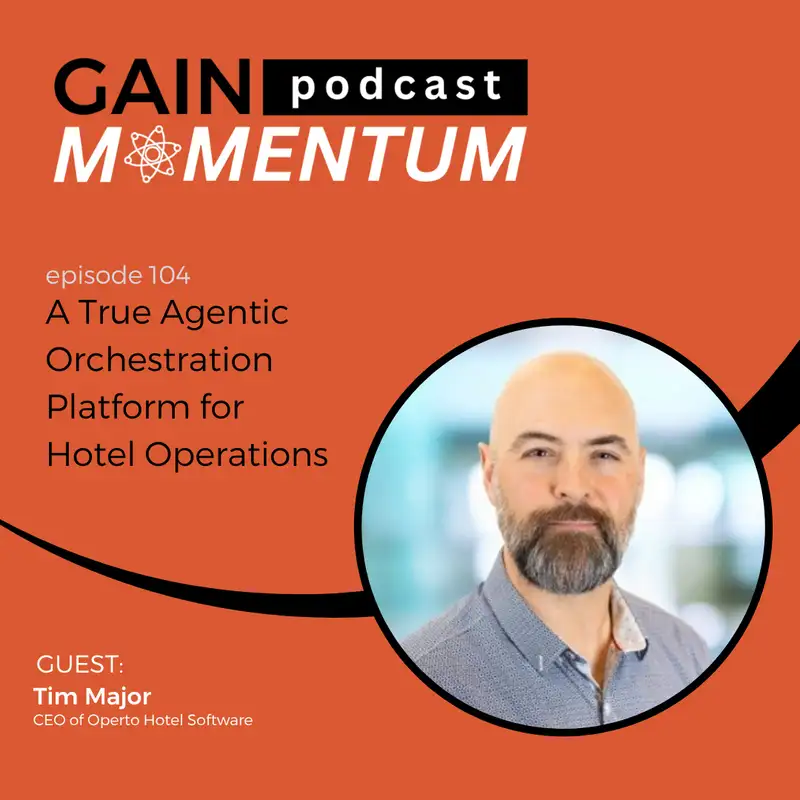
A True Agentic Orchestration Platform for Hotel Operations | with Tim Major
GAIN Momentum episode #104: A True Agentic Orchestration Platform for Hotel Operations | with Tim Major
===
Adam Mogelonsky: Welcome to the GAIN Momentum Podcast, focusing on timeless lessons from senior leaders in travel, food service, hospitality, and technology. I'm joined today by Tim Major, CEO of Operto. Tim, how are you?
Tim Major: I'm great, Adam. Thanks for having me. I'm excited to be here.
Adam Mogelonsky: Yeah. Well, it's exciting to have another fellow Canadian on the show. I'm in Toronto, you're in Vancouver, so, you know, let's not put on our Canadian accents, so that way the rest of the world can understand us.
Tim Major: Promise not to say aboot.
Adam Mogelonsky: Oh, about eh. Yeah, that's a big one. Yeah.
Tell us, to start off with, what is Operto? Give us the elevator pitch.
Tim Major: Sure, sure. You know, Operto has definitely made a major pivot in the last 18 months. Where they pivoted to is they were a company that was really focused on the short-term rental business since about 2016, but over the last 18 months or so, they went into shadow mode to really focus on a new category in the hotel industry, which is bringing to bear an AI workforce for independent hotels.
We really saw an opportunity to support hoteliers not to intervene with guests, but to really use AI in a way that's gonna support their operations, and really thinking about this holistically. We didn't want to bring to bear just individual tools or gap solutions, but try to think across distribution, direct booking, front of house, back of house—how should that all work together?
And then what was important too in this idea was that we didn't just want to bring software tools. We knew we needed to have an overarching sort of guardrails and intelligence layer that really thought about the overall knowledge in the hotel, the policies, live data from PMSs, RMSs. There's all these different tools, so how do we bring this all to light?
And that's why we kinda went quiet to really focus on this before launching last November, with the goal being to work in partnership with hotels, but also bring some technology forward that would really only be available to large chains and brands, given the experience Operto had. So that was, that's really what brought this to life.
Adam Mogelonsky: Something specifically for independent hotels. And that almost runs contrary to a lot of tech strategies where they're targeting the enterprise, the big fish, and you're looking specifically at offering tools to independents. What motivated that decision?
Tim Major: It was just realizing that a lot of the larger hotels, they've already been working with these tech stacks. They've already been deploying some of these internal AI tools internally. When talking with independent hotels, the conversations were they're aware of AI, they know AI is coming, but it's not knowing where to start.
And my background coming from Fullsteam and working with multiple PMS systems like Maestro and RoomKey PMS and things like that, we found that this is where the hotels really needed the support. They wanted the handholding to go, "How do I mature from maybe just a chatbot into the next AI solution? What does this mean? Take me through it."
And to be honest, that's an area that I've just always been passionate about, really helping these hoteliers that are working incredibly hard to make sure they have occupancy and strong ADR. How do we help them with technology? And so it was really personal passion tied with there's a lot of independents.
So we're focused in North America. There's probably somewhere in the range of 30 to 60,000 independents. You have the same thing in Europe. It's just such a rich market to work in.
Adam Mogelonsky: I love that you call it a rich market because it's a fragmented market, sure, but it's rich in that these independent hotels have such a great identity and character in offering these great experiences. But to execute those experiences requires so much operations that bigger brands or collections can distribute amongst multiple properties.
So by you coming in and essentially enabling an agentic layer, you're allowing hotels that are independent to be just as good as some of these clustered management properties. I would also color what you just said is that independent hotels, they don't know where to start, but also they don't have time to know where to start.
To even look at where to start on the path of AI integrations, that just requires a lot of time to figure out that critical path, that strategic plan. And if you can come in as a platform that already has some out-of-the-box tools to get them started and help them realize those wins, both what's reflected on the P&L as well as just time savings for managers to then deepen their exposure to agentic workforce and then realize even more efficiencies.
So it really is incredible that you're targeting and specifically helping independents in that way.
Tim Major: Well, and that's what we see as our job is even though this is a technology offering, this is an industry built on really high-touch experiences and face-to-face experiences. So we see hotels really coming to us and saying, "We're not gonna tell you exactly what you should use. We want to actually learn about your hotel. What are your challenges? What's unique about your brand?"
And then suggesting where you can start with AI, like what's a piece that makes sense day one, and then where could that be in 365 days from now, really talking through that arc.
Adam Mogelonsky: Wow. Yeah, that's great. So that's almost an advisory service on top of that to guide which deployment will first impact you and essentially get your feet wet, and then enable further automations and further agentic deployments down the road.
Tim Major: Yep, exactly. Exactly, 'cause if you think about this, this is like the dawn of the internet, where it's now we have web-based tools. We're gonna pass things over ethernet. It's the dawn of the API or VoIP. It can't just be something we throw at people and think it's gonna work. It's gonna take a consultation.
It's gonna take doing this in partnership, and that's actually why I came over to Operto, because it's so exciting to be in partnership with hotels to figure this out. 'Cause it's not gonna be perfect, but it's happening so fast, we need to do it together or a lot of hotels, I think they're gonna get stuck a little bit behind the curve, and that's not fair.
Adam Mogelonsky: So you mentioned it, you recently stepped into the role of CEO, and as they say, the first two quarters are critical. So what has your journey been like at Operto to date? What plans have you initiated? Overall, what does success look like during this initial stretch?
Tim Major: Yeah, that's a great question. Operto is already very successful. They've been around since 2016, but they were focused predominantly in the short-term rental market and really had a strong brand there.
My stepping into the role was really intending to broaden out their focus from, they already had about 25% of their customers in hotels. Now it's to really broaden that out. So my focus has really been leaning into that, meeting with independent hotels, really understanding their perspective on AI and mapping this product suite over to that.
To be honest, when I think about success and what's been happening in the last couple quarters, it's really come through meeting with hotels and seeing how they're changing thinking about their jobs and their workflows. Because we're thinking about this as an agentic workforce.
So if you think about it as a hotel, you're hiring staff, you're creating your org design. If you think of this similarly, it could now be, for example, you have a marketing manager. The marketing manager has 10 things in their job responsibilities. When you start to use AI, you might go, okay, instead of those 10 being the marketing manager's job alone, you have three of those job responsibilities which are actually the co-pilot responsibilities of the marketing agent.
So you're starting to build jobs that have this joint combination of people. And so the most gratifying thing is happening where I'm on a call, it starts off where the general manager is not really sure where to go, but after an hour, at the end, the gears are starting to realize that AI is going to complete a few things for me that have never been completed by a computer before, or by technology, or by an algorithm before, and starting to rethink what a workflow is.
It's really a paradigm shift in workflows and how to approach something. And that's the most fun because I think about my job, you think about your job. If you could give a few tasks that are important and a computer would just come back to you with the outcome as opposed to this is a decision you need to make or more steps you need to take or a report you need to read, it's really quite game-changing when it just comes back and says, "I actually did that for you, and it really worked out really well. Here's what happened, and I'm gonna do something for you next. What do you think?"
And so it's a very different way of working, which to me has been success with the hotels we've worked with so far.
Adam Mogelonsky: Human on the loop. Is that correct?
Tim Major: Yeah, I'd say it's a good way of looking at it, where the human is really working with the agent to provide information, context, teaching it, and then you're changing your level of delegation. If you think about it like if you brought on a very junior staff member, you wouldn't require them to do the highest level of responsibility.
You'd first ask them to come back and teach you, show you two things they can do, and then give them a tick box and go, "Great job. Excellent work. Now you're ready for the next task." That's what's happening with these AI agents until they get to that sort of highest level of delegation where you just send them off to take a task on themselves.
Adam Mogelonsky: And to walk us through that, because that does require, I guess, a level of confidence both on the human side as well as on the data side and the training side for these agents. Can you walk us through one specific example of taking an agent from out of the box, trained to be human in the loop, and then finally getting that trust to make it on the loop?
Tim Major: This is so, in how we've approached this, it's kind of a distribution direct booking agents and then front-of-house agents and back-of-house agents. If we look at this from the direct booking side, let's take the booking agent once it comes to your website. What does that booking agent need to know if they were almost like a travel agent for your hotel?
Well, they need to know not only your availability rates and inventory, which is kind of your PMS data, it also needs to know all the context around your property. What are your amenities? What is your location? What are the things that are around you? Are you a destination property or more of a property where people are staying for business?
They need to know all of these contextual pieces. So the initial step of these agents is to actually pull all this information. So it's gonna pull it from all these live data sources. It's also gonna scrape your website, pull in all that data. It's gonna structure all of it in a way which LLMs and agents are gonna find useful.
That's the first piece. So let's say in the booking agent, you can then watch the booking agent have conversations with guests with all this information and see if you think it's accurate or not. And we actually have, for example, a playground where you can interact with it as a hotel and first gain that trust.
So think of it like role-playing with a new front desk agent or concierge. You could role-play with it and go, "Okay, I feel like you're 75% there. I'm gonna send you off now to work with customers."
Then how you're building confidence over time is what we actually have too, which is kinda neat, is it's almost like autopilot on a plane, where the pilots are flying, but they put on autopilot, and autopilot is watching the pilots.
So in the case of agents, we have a supervisor agent that's actually watching these agents interact, and it's looking at all of the data that you have in your repository. We call it the AI hub. So all this data about your hotel and all this live data from these other systems, it's watching the interaction.
It's grading it. It's saying, "Okay, I think that was 80% accurate. I think that was 85% accurate." And based on the type of guest you're interacting with and when, you can actually decide as a hotel where you're comfortable.
So you might say, "Unless it's 90% accurate, I don't want that going to a customer." And the agent will stop it. It'll go, "I'm not gonna send that to the customer. I'm gonna send that directly to a hotel person because it needs a human touch."
So you can decide these confidence intervals and then control the system that way. And then as it gets better, you crank up those confidence intervals and you say, "Okay, I'm good if it's 95% of the time."
And then you can actually see how many interactions are accurate 95% of the time. So it's a lot like instead of thinking about it like technology and computers, think of it much more like training staff and training people.
Adam Mogelonsky: This is orchestration. Is that correct?
Tim Major: Yeah, exactly. And I think because as each of these agents are developing this information, you want to be able to orchestrate this across the stay experience ideally. That's how we built this architecture holistically to go, we know what they're looking for when they book. How does that information relate to their in-stay experience?
And so you're carrying this context along where it's relevant, and that's kind of the orchestration piece where you're ensuring when humans need to get looped in and when the agent can actually be assisting those humans, and thinking about that all the way along the journey.
Adam Mogelonsky: Yeah, and I like that you start with bookings because a challenge that independent hotels have is that they generally pay larger commissions to third parties because they don't have the negotiating power.
So, the tools that you're implementing, it seems like they have a lot of applicability for driving this next generation of bookings, which are AI search and bookings that are natively made within LLMs. Is that an area that you're exploring?
Tim Major: Yeah. Absolutely. And I think if you think about a starting place for AI and where it's strong, if you did a matrix of high impact to the hotel on one axis and you did sort of knowable data on the other axis, direct booking is a really natural place for AI to work very well because unlike in the past where you had to rely on APIs for information, we now have access to real-time information through APIs, but we can also use AI agentically, meaning that it can actually go and do things like a human.
It can go and look at screens, it can look at pages, it can gather information and then categorize that information and make decisions. So when it comes to booking, you can actually know, for example, what your position is. It can actually go to a search engine results page and see where are you?
Are you doing a good job with your meta listings? Are you doing a good job with your Google Ads? What competitors are coming up and when? A lot of these tasks, marketing agencies were doing in the past, but it's a lot of manual effort and manual tactics where this agent can actually do it twenty-four/seven in real time from many different places.
So for example, your marketing agency might be just in the same city as your hotel. Well, a lot of times they're only seeing geo-fenced information that's relevant there. An agent can be looking at all of this information real time from all your different feeder locations and helping to come up with strategies and decisions and actions that can help you get better positioned on the search results pages and ultimately drive more bookings.
Adam Mogelonsky: Operto, is that what you're calling it?
Tim Major: That's correct. We're calling the suite of agents the workforce agents, Alpata One.
Adam Mogelonsky: Okay. And what does it really mean to have a shared intelligence layer? You've mentioned the confidence interval and the data. Perhaps you could color that through how this will actually be reflected in owners' returns in terms of impact on the P&L.
Tim Major: Sure. How I think of this intelligence layer is we're shifting from where data needs to live to ultimately interact with your guests and how does it do that in an accurate way.
Right now websites and OTAs have become the predominant place that people are searching online. You have your aggregate review sites like TripAdvisor, your OTAs, your website, tourism websites. That's where it's all living.
The intelligence layer needs to be where all of that information resides in one place because if agents are missing a piece of the story, they just can't accurately work with your guests.
So that might be, for example, there's tribal knowledge in your staff. For example, we might want videos of those staff talking about your properties, learning from them. That becomes part of the knowledge center.
You're pulling in all of your website data and structuring it. You're pulling in all of the information from your OTA websites and reviews, and you're structuring it. You're really just putting this in one place in a structured way so all of these agents know how to find it.
Imagine a future, which is coming pretty quickly, where guests can potentially create their own agent on their computer with their own chip that's ultimately running a localized LLM, and they're then using that agent to go out into the world and determine their travel and bookings and potentially doing those bookings.
Well, that information needs to be findable somewhere. So that's really that intelligence layer. That's really the data lake layer of that. So you're gonna have the concept of a hotel data lake, your guest information data lake. It's all residing there.
But then you want to wrap that and ensure there's some controls in terms of privacy, GDPR, those layers in terms of the ethical component of using information to service these agents, but also tied with the notion of confidence like we were talking about.
How do you train it? How do you believe it? How do you have confidence in it? So all those tools need to wrap around this intelligence layer, and that's one of the things that was the first thing that we constructed before building out the agents, because that's really the core of where we see the future going.
Adam Mogelonsky: Wow. So now we're looking at you have all this data, you have these agents, and then what we've discussed earlier with other thought leaders in hotel technology is this whole idea of enabling creativity in hospitality.
And realistically, if you have more time, you have more physical bandwidth, you can then put that back into service augmentation. So I'm just wondering, what are you seeing in terms of ways that hotels can augment service once they have all these agents in place to really become independently spirited to the maximum?
Tim Major: I think two things come to mind. One of them is the obvious, which is just the freeing up of time. Everyone is using ChatGPT, Claude, and Gemini now for example. There’s an event coming to town for your property and you want to put custom notes about that local event, so maybe ChatGPT helps you draft that information.
So there’s some of that component to it, just saving you time, and I think that’s where a lot of these agents can take away redundant tasks that don’t require as much creativity. That area is probably one of the main benefits right now.
For example, humans are still really good at creating custom packages. You have a wellness package for the winter coming up. That idea of partnering with different activity providers and creating unique packages still requires the human element. That’s probably not a great fit for AI right now out of the box.
But that’s where hopefully you’re getting freed up to really customize what works for your brand and your hotel. You’re getting freed up to do more of those activities.
Adam Mogelonsky: Yeah, just to drill into that example, AI works perfectly for part of the wellness package. You want it to handle as much as can be automated. From there, you’re allowing wellness practitioners to partner with you, and you’re automating internal communications, itinerary planning, task routing, et cetera.
Then you’re allowing those wellness practitioners who want to be front and center with the guest to be even more front and center.
Tim Major: What also relates to that is where AI can be beneficial is that hotels often have a lot of screens, interfaces, and data in those systems. AI can surface data for a front desk agent or someone working in the hotel so they can quickly access information on a guest. That might include past stays, history, and preferences in a way that is easy and quickly consumable.
That allows you to be present with the guest, to be creative, or to adapt something in an itinerary or something related to a previous stay. Doing it in a way that allows you to use human judgment without the computer directly making decisions with the guest.
Because that’s where social norms come into play. Just because we have all the information doesn’t mean we want to make decisions on all of it. It still requires that human layer to be creative and decide what makes sense for that guest in that moment.
Adam Mogelonsky: Yeah, it’s interesting you mention that. What we’re talking about is having all this data on the guest, and then the front desk person or spa receptionist needs to have exactly what they need in front of them. From there, they have the lens to know what to do in that moment and apply creative human judgment.
Is there a term for that, like contextual suggestions, or something that gives us a nice buzz term for this?
Tim Major: I don’t have a term for it, but we could invent one here today. I like that idea: contextual suggestions, or real-time guest insights. For example, before someone starts their shift and wants to see who is in-house, they could quickly review each guest and get a depth of data that would have been difficult to acquire otherwise.
In a moment, you could learn ten things about that guest and hopefully be more creative in the moment with them.
Adam Mogelonsky: Yeah, and going back to your initial point, there’s often too much information and too much reporting. Wouldn’t it be better if we could train an AI agent in a human-on-the-loop manner to not just deliver another report or insight, but actually act on it and then tell us the results of those actions?
Tim Major: Exactly. And the way we’ve built each of these agents is that you also define the voice you want them to have. What tone should they use? What should their background be? What should they emphasize?
For example, if you had someone analyzing your guest data, what would you want to know and how would you like it presented for your brand? Then your front desk agent receives summaries in the tone, style, and format that fits your brand. It helps them understand how they should be communicating and representing the hotel.
So it becomes a training tool at the same time.
Adam Mogelonsky: Wow. Now, with AI being the big trend in hotel technology and enabling independent hotels to compete at a larger scale, what other big trends are you seeing in hospitality, and how is Operto helping?
Tim Major: Yeah. I think one of the big trends that I’ve been watching over the years, but I had assumed it had gotten better, which was a wrong assumption, was this notion of predatory OTAs and these predatory affiliates. I’m using the term predatory as these affiliates that are functioning and taking a different approach than say Booking.com or Expedia.
I guess everybody knows in 2008 the OTAs kind of came in, and then I saw this pop into my feed again the other day where in 2015 the American Lodging Association noted there was about 15 million of these scam sites that were out there. But I had sort of assumed it just wasn’t happening as much.
Then six months ago or so, we dug back into this when we were looking at some of these agents and what some of the marketing agents and distribution agents could do. As much as last week, I noticed that companies like Reservation Desk, which is an affiliate, and HotelsOne, which is an affiliate, are running around 200,000 ads in Google and about one ad per hotel that is just pretending to be the hotel itself.
They’re not even suggesting they’re an aggregator. They’re suggesting they are the hotel. And if you call them, we called them, and they are pretending to be the hotel, and the interaction is as if they’re the hotel.
This really stood out to us as something that is unfair because the search results page has seen its format changed in recent years where you have such a dominance of sponsored results showing up. We built some tools that allowed us to look at all these ads, all these hotels, and all these positions, and it was dramatic how often these sites were coming up in the top listings for the hotel’s brand names.
That’s where we saw that AI agents could immediately play a role in this because marketing agencies are playing a role in attacking this too, but the ability for the AI agent to see this position, see this predator, and then run a bunch of tactics and outcomes to move them out of position.
We found the AI agents could actually go in and eliminate them. It could report them to Google. It could use the legal framework to know how to report and act agentically. It could create ads that not only outbid them, but outbid them at a lower price because what they’re doing is actually against the policies of Google or even some of the OTAs.
This is where we saw an ability to really attack this problem. Because we’re attacking the OTA commission challenge, it is such a big part of expense being funneled out from properties. That was one of the areas we really leaned into and are seeing some of the most success.
Adam Mogelonsky: Wow. And just to give a sense of context here, how much benefit would you realize in terms of net revenue by using agents to move guests away from these predatory OTAs into direct bookings?
Tim Major: We’re seeing that the top listings on your hotel brand name, which is a very high-intent word—the guest already knows you, and you’ve already invested in creating that experience—they want to book directly.
That represents about 60% to 70% of booking traffic that is going to these predators. So you might have Booking.com at the top, but then a predatory link right below it, then Expedia, then another predatory link below that.
A very high percentage is going to those four. From the numbers we’ve seen so far, about 25% of that traffic is booking through those predators. Depending on how much a property is using OTAs as a channel, that adds up quickly.
We’ve seen the possibility of moving a hotel from multiple percentage points reduction in OTA dependency to up to 10% or more in moving that OTA commission line.
It’s unique to each property, but that’s the general math. It’s quite shocking how much can be saved by deploying these tools now.
Adam Mogelonsky: That’s just money being siphoned off the top that could go toward operations, service, or back into marketing and sales.
Tim Major: Yeah. And that’s the most obvious return. But the other part, which is just unfair and kind of ridiculous, is that guests think they’re working with the hotel.
When a hotel has a policy that isn’t the same as what they booked under, they feel like they’re getting an unfair bill. Some of the bills we’ve seen don’t even match what was on the website.
So now they have a negative initial experience and they’re calling the hotel asking what’s going on, but it’s not even the hotel driving that. It creates these negative experiences.
So not only are they not getting the direct booking opportunity because it’s going through an OTA affiliate network, they’re also creating a negative perception of the property that isn’t even accurate. They lose on two fronts.
Adam Mogelonsky: Fraudulent is the right word.
Tim Major: Yeah. We see it as hijacking. They’re hijacking the brands of these hotels. It’s a huge opportunity to use tech to fight these hijackers.
Adam Mogelonsky: And with the dawn of machine readability and AI search and then AI bookings, how do your tools, or more generally, what tactics can a hotel use to ensure that when an AI is searching hotels and then eventually booking straight through on behalf of a guest, that it is getting its information from the direct channel and then booking direct?
Tim Major: That's a good point. We're seeing traffic move to the LLMs. Recently when Google moved the search results to add the immediate responses from the LLM to the top, they saw a meaningful drop in traffic. So we definitely see it going to the LLMs.
I think what's really important for hotels here is they're starting to think about what do I need to do to make sure I'm positioned. There are various tools out there. We also created one that allows you to run your hotel to see if you're showing up in Claude and Gemini on key phrases and the types of things people are searching for.
A couple tips on that: you want to make sure you're starting to structure your data in a way that is consumable by the LLM. Think about FAQs. People are using conversational language, so having a generous amount of FAQ information on your site helps.
It's also making sure you're telling the story on your website, and this comes back to that AI hub piece. You want the information in one of these hubs that is readable by LLMs, but you also want to be telling the unique story for your brand—what makes you different, your vision, what you're trying to provide at your property.
Really getting that narrative across helps LLMs know when to reference you in long-tail searches. And then it’s what I mentioned earlier: structured data. It needs to be put somewhere where it can be read.
Those are some of the main things I’d think about in being discoverable in LLMs.
Adam Mogelonsky: And the structured data to be discoverable—is that going to be called the data layer that underpins a website, or will it reside elsewhere?
Tim Major: It can be in many places now. LLMs use something called MCP servers, which is basically a way for them to talk to a set of data. So it’s making sure there’s a solution where you’re taking all your data and making it available to the endpoints that LLMs are looking for.
That’s the main thing hotels want to build, because over time as search traffic declines, you want to make sure you're available in these channels.
Adam Mogelonsky: Very interesting to see this emerge. It’s basically, as you said earlier, the dawn of the internet, now the dawn of AI. And part of the dawn of the internet was the dawn of OTAs. This is the next big environment for hotels to play in.
What does it look like five years from now when one-third of your traffic is coming through AI search and AI bookings?
Tim Major: What I think is really exciting about this, and one of my reasons for getting involved, is that since the dawn of the internet there was this idea that hyper-personalization was going to happen. We were going to have all the information and treat every guest like we know them.
That promise didn’t fully come to fruition. It came in parts—Google, LinkedIn, Facebook are very good at customizing to user behavior—but it didn’t become true across general business tools.
I think AI, combined with structured data, actually has the ability to lean into hyper-personalization, because you can know so much more than a human reading reports. You can have accurate information at your fingertips to respond in a personalized way.
That’s where it gets really exciting—moving in that direction and trying to make it real.
Adam Mogelonsky: I mean, it's incredibly exciting. A little bit overwhelming because there is so much that you can do with agents that are specialized in a specific task, and then it's just a matter of thinking about where you want to deploy the agents and how to orchestrate them.
Tim Major: Exactly right. And I think part of it is trial and error. It’s just starting. I think it’s one of those things where it was probably hard to know what the first thing you wrote into ChatGPT was. It was like, “What is the weather?” Simple things. And it took that behavioral change to learn how to use AI.
I think for hotels, I suggest the same thing. It’s putting your toe in the water, starting to pick your first areas and which agents could work for you. There could be ten agents to choose from, but maybe for your hotel it makes sense to start with one.
Distribution is a great place, in my opinion, to start, and to really start to learn only by using it. I think that’s going to be critical.
Adam Mogelonsky: Yeah, it’s a great place, and you’ve already shown and explained just how much value can be realized just by fighting these predatory OTAs, getting front and center for AI bookings that are on our doorstep. So to close out, what else is there? What’s next for Operto?
Tim Major: There is no shortage of things to work on in AI. Our focus is going to remain on where AI is able to help independent hotels the most, where it is easily consumable as a first step, while keeping in mind orchestration across all of the guest stay experience.
That foundation of privacy, guardrails, confidence, good information, and a good source of truth is really what we are focused on.
From there, it’s ensuring we can make this available as quickly as possible to hotels. We are seeing LLMs getting faster and smarter, and it is becoming more dominant as a travel tool. We just want to make sure it is available and that we are bringing it to market as soon as possible.
Adam Mogelonsky: And the “soon” is going to be very soon because everything with agents and LLM developments is happening so fast now. There is something new every week. It’s very exciting, a little overwhelming. But going back to one of your initial points, part of what Operto does is advising independent hotels to map out that path, get their feet wet, start with distribution, then expand into other departments, and really round out that agentic workforce. Tim, is there anything else that’s important that we haven’t talked about yet?
Tim Major: No, but I think in the weeks ahead there’s going to be no shortage of new things to talk about.
Adam Mogelonsky: Yeah.
Tim Major: I’m looking forward to delving into those topics.
Adam Mogelonsky: Awesome. Well, Tim, thank you so much for coming on the show. It has been absolutely fantastic to have you on and an incredible overview of what to get excited about for hospitality in the next few years. And I love that you’re helping take a stand for independents that are often relegated to the bottom of the pile for technology developments. You’re really helping them come to the forefront and realize this next evolution in technology. Thank you.
Tim Major: Thank you, Adam. Really appreciate you having me on. Really enjoyed it. That was great.
Adam Mogelonsky: Yeah. Thanks, Tim.
Tim Major: Thanks.